

Both CppDepend and SonarQube are static analyzers that offer a rule-based system to detect problems in C/C++ code. However, the CppDepend default Rules-Set has very few overlaps with the SonarQube rules
Basically, the SonarQube rules are good at analyzing what is happening inside a method, the code flow while the CppDepend code model, on which the CppDepend rules are based, is optimized for a 360 view of particular higher-scale areas including OOP, dependencies, metrics, breaking changes, mutability, naming...
Concretely SonarQube rules can warn about problems like a reference could be null, while CppDepend can warn you about too complex classes or components, and offer advice about how to refactor to make the code cleaner and more maintainable. Another point that makes the CppDepend ruling system unique is comme il facilite l’écriture de règles personnalisées. With CppDepend a rule is a LINQ query, that queries a code model dedicated to code quality, edited live in Visual Studio, compiled and executed live at edition time. Concretely, this piece of code below is a fully functional rule, could it be simpler?
// <Name>Classes must start with an I</Name>
warnif count > 0
Application.Types.Where(t => t.IsClass && !t.SimpleName.StartsWith("C"))
When defining a custom rule with CppDepend, the user doesn't need to create a project, create a source file, step into the edit/compile/debug cycle, maintain a binary dll that requires effort to be shared, versioned and integrated. With CppDepend custom rules are raw texts, embedded as XML CDATA into the CppDepend project or rule files. Also, the documentation and how-to-fix guidelines can be embedded in the rule source code as comments.
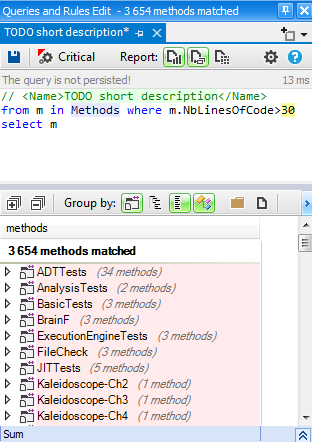
Also, each CppDepend rule can present its issues with extra data that will help to understand the problem and fix it. Moreover, each rule can embed two formulas that attempt to estimate both the coût de correction du problème et le coût annuel pour laisser le problème non corrigé, aussi appelé dette-technique et le intérêt annuel du problème. Since these formulas rely on what really matters at fix time, this makes the debt estimations smart.
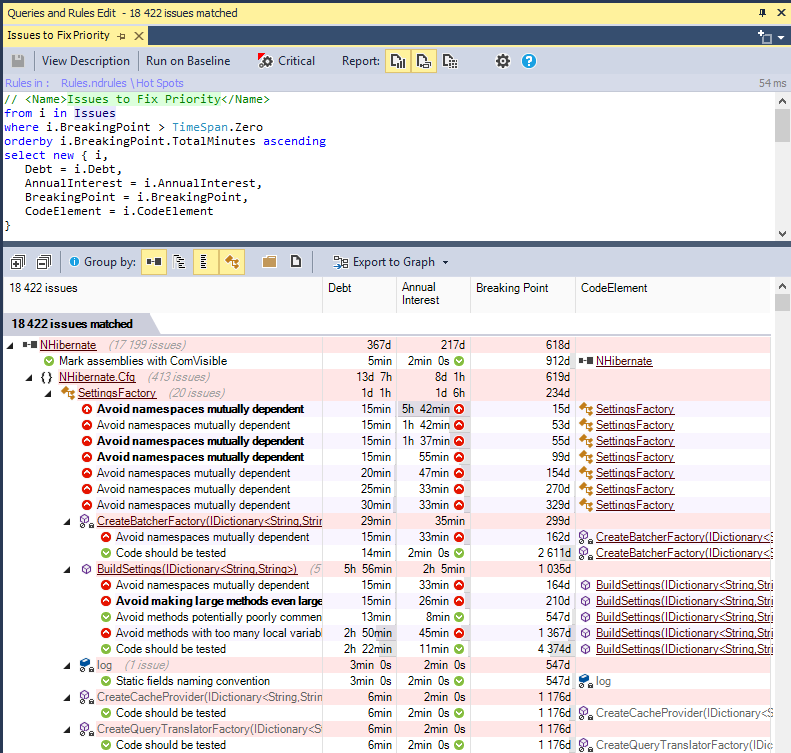
Finally, with CppDepend each rule is run in a few milliseconds even on a large code base. As a consequence, all rules can be passed in a few seconds (typically 2 or 3 seconds on a real-world code base), both in Visual Studio and in the Continuous-Integration system. As a benefit, after each compilation and also at check-in time, the developer instantly knows about the new and fixed issues since the baseline, and the impact in terms of technical debt fixed or created. Now let's explain how to integrate CppDepend rule results into the SonarQube system to cumulate the strength of both products. I - C/C++ Plugin Prerequisites
- Installer SonarQube.
- Installer SonarQube Scanner or the old Sonar Runner.
- Ajoutez le répertoire bin de SonarQube Scanner ou SonarRunner à la variable d'environnement PATH.
- Copy the sonar-cxx-plugin-cppdepend-1.0 from $CppDependInstallDir$/SonarPlugin to the $SonarQubeInstallDir$\extensions\plugins directory and restart SonarQube.
- Les règles CppDepend par défaut sont chargées dans le dépôt de règles SonarQube. Cependant, si vous devez personnaliser ces règles, vous pouvez définir vos propres règles personnalisées en utilisant le chemin du fichier .cdproj situé sous l'onglet Administration de SonarQube.
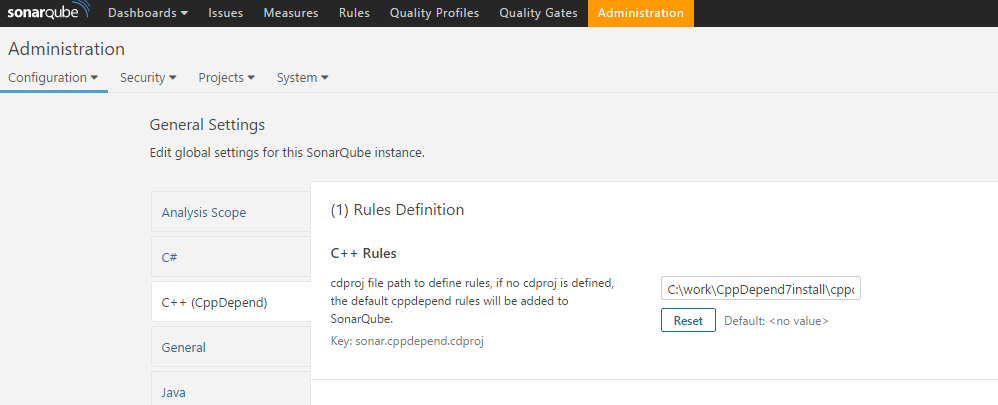
- Vous devez vous connecter en tant qu'admin et activer les règles CppDepend dans le profil souhaité.

- Execute $CppDependInstallDir$/SonarRunnerForCppDepend.exe "the .cdproj file to analyze "For example: SonarRunnerForCppDepend.exe C:\MyWorkspace\test.cdproj. SonarRunnerForCppDepend will analyze the cdproj file using CppDepend and launch the SonarQube Scanner executable to load the results into SonarQube. Any other argument passed to the SonarRunnerForCppDepend after the cdproj file argument will be passed to the SonarScanner command. For example you can pass the version with this command SonarRunnerForCppDepend.exe C:\MyWorkspace\test.cdproj -Dsonar.projectVersion=3.0
- Analyse multi-modules : a CppDepend project could contain many C/C++ projects.
After the analysis, CppDepend does not put all the code in the same SonarQube module. However, it creates a multi-module sonarqube project to isolate each project into a separate module which makes the code navigation very easy.
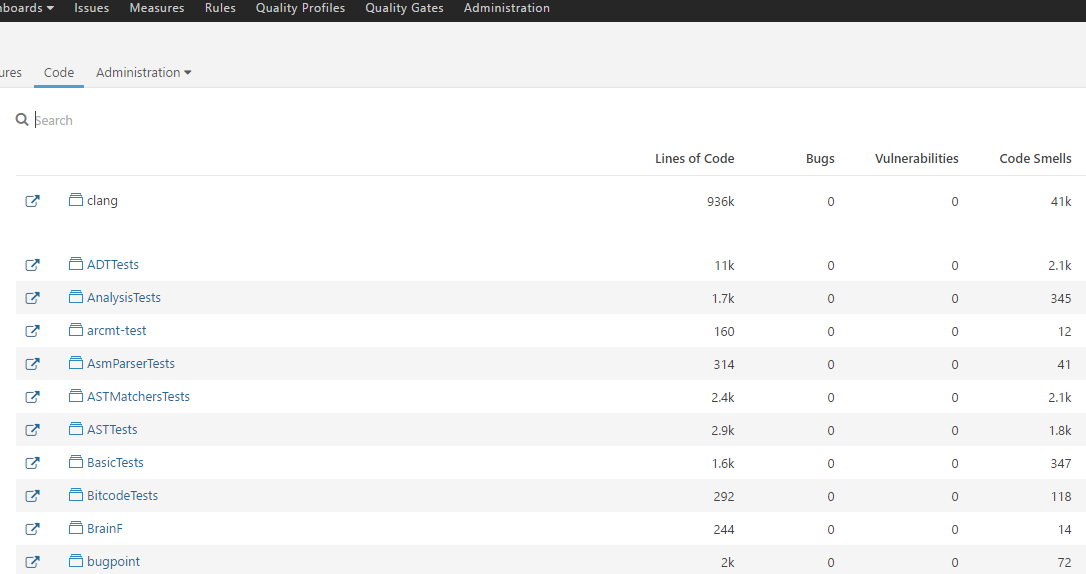
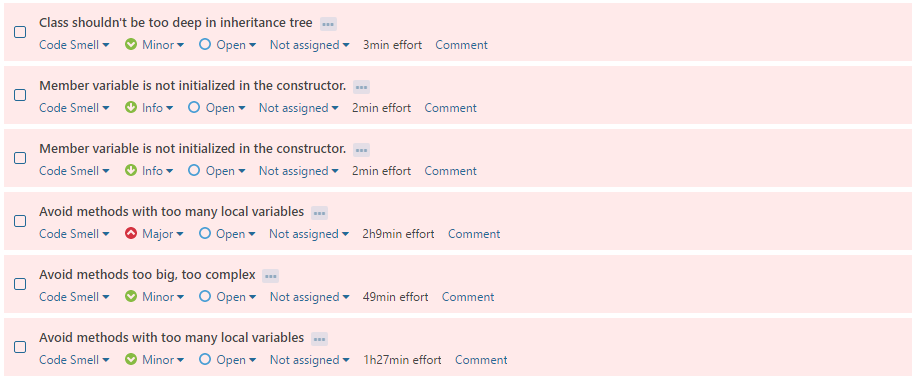
- Problèmes : CppDepend fournit par défaut plus de 250 règles, que vous pouvez facilement personnaliser entièrement. CppDepend offre un moyen puissant de calculer la dette technique des problèmes. La dette technique CppDepend et la sévérité des problèmes sont transmises à SonarQube.
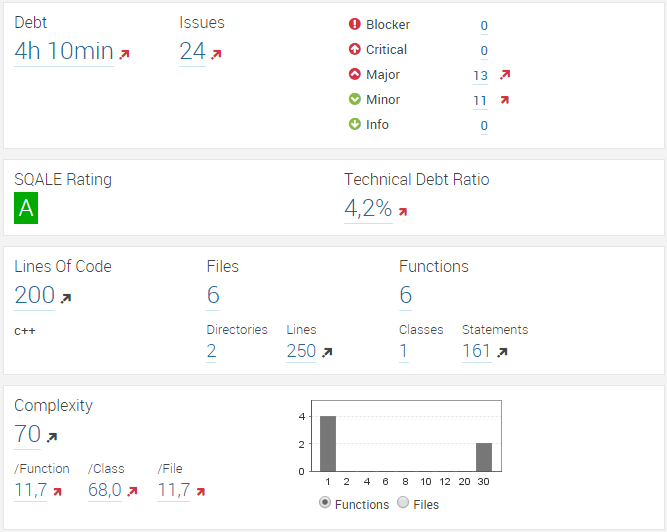
- Métriques standard : le plugin calcule toutes les métriques standard de SonarQube.
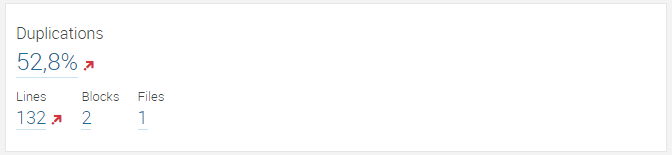
- Duplication de code : Les duplications sont détectées par l'outil CPD intégré à SonarQube.
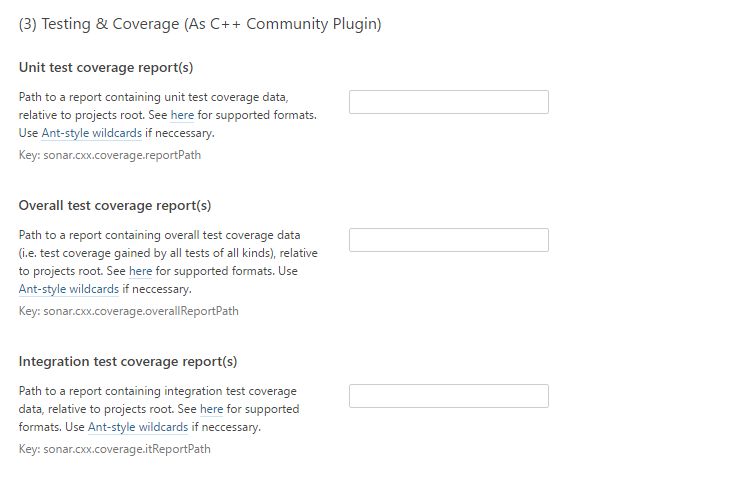
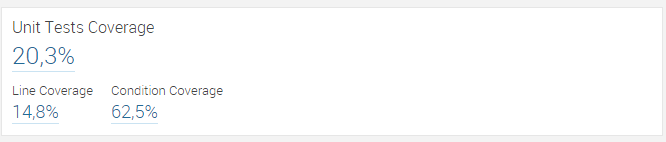
- Couverture : Le plugin charge les résultats de couverture depuis les fichiers de résultats XML Cobertura et Microsoft Visual Studio. Cependant, vous devez définir le chemin où se trouvent les fichiers XML de couverture.
The C/C++ SonarQube plugin is easy to install and to use. The rules customization is very simple. You can try it and give us your feedback.