

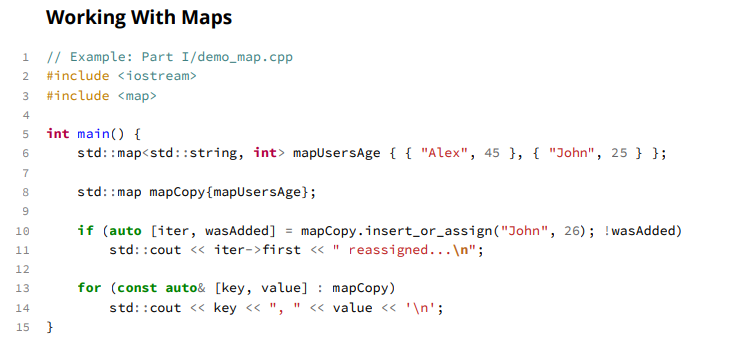
Since its creation, C++ has evolved continuously and passed many major milestones, from C with Classes to the rise of the newer standards. From 1991 to 2011, the language evolved slowly, and the evolution came from libraries like the STL and Boost. However, since 2011, many features were added to the standard thanks to C++11, C++14, C++17, and the upcoming C++20. Recently, the C++ community has been promoting the use of the newer standards to modernize existing code bases. Bartłomiej Filipek is one of the most active bloggers in the C++ community, and he helps promote the newer standards. He wrote an excellent book about the C++17 standard features, and here’s a quick review of his book. A pragmatic approach In the world of computer science, there are many academic books mostly intended for students, and other books mainly intended for developers who need advice on how to solve real problems when developing a product. You learn by coding — indeed, very few pages contain no source code, and every explanation is demonstrated by at least one code sample. The code samples are very well formatted, easy to read and clean.
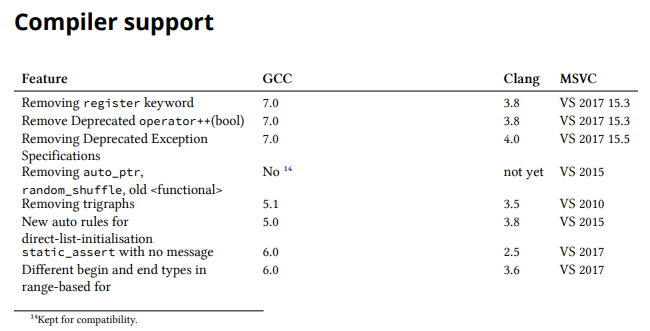
The author also provides plenty of practical information, like the compiler support for each feature.
 The whole picture from the beginning:
In general, to get an idea of a book’s content, we can take a look at the table of contents and read the introduction. However, in many cases that’s not really enough to have a clear understanding of the book’s goals. What’s interesting about this book is that it has a “Quick Overview” section of 4 pages that clearly explains the content of the book. New language features demystified: The book covers almost all the new C++17 features, grouped by section. Even though some features are difficult to understand, Bartłomiej Filipek adopts the “keep it simple” approach, and every feature is very well explained using simple examples — for example, in the new template features section, which includes:
- Template argument deduction for class templates
- template<auto>
- Fold expressions
- if constexpr – the compile-time if for C++!
- Plus some smaller, detailed improvements and fixes
You will be impressed by the clarity of the explanations and the code samples. Every C++ developer, even a beginner, can understand the purpose of these new features. New standard library features demystified The good news is that the standard library evolves with each new standard, and many interesting new features are added. Here are the C++17 standard library features covered in the book:
- How to represent nullable types with std::optional.
- What’s a tagged union? And why do we need a type-safe union in the form of std::variant?
- How to represent any type with std::any.
- How to use string_view to gain performance without breaking your application.
- What new string operations are available in the Standard Library.
- How to work with the filesystem using the Standard Library.
- What the parallel algorithms are.
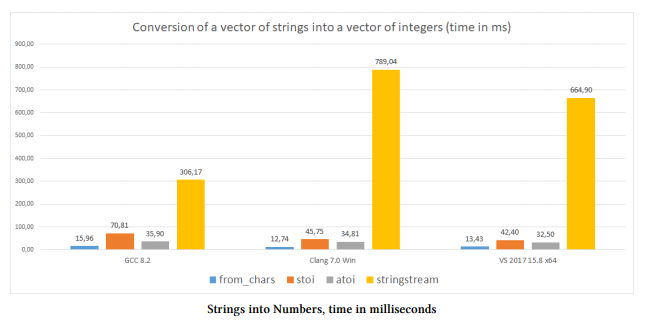
Each feature is explained in detail using many code samples. And what’s interesting is that the author also talks about performance and memory considerations, explaining how a feature can impact performance and memory usage.
 More examples and use cases
At the end of the book, several other interesting problems are presented; the author tries to give many solutions and explains how the new standard solves them better than the old features. Conclusion: When reading the book, it’s clear that the author is a programmer who has worked on many C++ projects to solve real problems, which explains the pragmatic approach of the book. We recommend this book to every developer who wants to master the new C++17 standard. The book is available on Leanpub, and as a reader of our blog, you can buy it for about 15% less by using the following coupon link: https://leanpub.com/cpp17indetail/c/codergears