

C++ is a powerful programming language that provides a wide range of libraries to help developers build efficient and effective software. These libraries cover a variety of domains, including general-purpose programming, graphics, networking, databases, and more.
When you need to use a library in your C++ project, the first question to ask is whether it fits your needs. Choosing a library can be risky, especially when many competing options are available. The wrong choice could cost a development team many hours of work.
1- Licensing
The library's license is the first thing to check. Before exploring its capabilities further, it is essential to verify that the license is compatible with your project.
2 - Does the library satisfy your needs?
It is also important to check whether the library truly meets your needs. Surprisingly, many developers only realize after building a small proof of concept that a library is not suitable for their project, despite initially being convinced by its feature list, tutorials, or webinars.
3 - Is the community active?
Many issues can arise when using a library. The people best placed to help you solve them are often members of its community or the library's maintainers. It is therefore wise to choose a library with an active community; otherwise, you may spend days trying to resolve problems on your own.
4- Documentation
Using a well-documented library can save you a great deal of time. Conversely, poor documentation can make even simple tasks unnecessarily time-consuming.
5 - Do you care about performance?
Performance is not always a top priority when choosing a library, in which case you can skip this step. However, if performance matters to your project, review available benchmarks and, ideally, build a proof of concept to understand the library's behavior before making a decision.
Let's explore the most popular C++ libraries:
1 - STL
The STL is a collection of template classes and functions that provide common data structures (like vectors, lists, queues, and stacks) and algorithms (such as sorting and searching). It is an integral part of C++ and is widely used for its generic programming capabilities.
2 - Boost
Boost is a set of high-quality, peer-reviewed libraries that extend the functionality of C++. These libraries cover a wide range of areas, including smart pointers, regular expressions, multithreading, networking, and more. Many Boost libraries have been proposed for standardization and some are already part of the C++ Standard Library.
3 - Folly
Folly (a loose acronym for Facebook Open Source Library) is a library of C++17 components designed with practicality and efficiency in mind. Folly contains a variety of core library components used extensively at Facebook. In particular, it is often a dependency of Facebook's other open-source C++ projects and a place where those projects can share code.
4 - Qt
Qt is a cross-platform application framework that simplifies GUI (Graphical User Interface) development. It provides a set of libraries and tools for creating desktop, mobile, and embedded applications. Qt is known for its ease of use and flexibility.
5 - Poco
Poco is a set of C++ class libraries that simplify and accelerate the development of network-centric, portable applications. It covers areas such as networking, file systems, and thread management.
6 - OpenCV
OpenCV is a computer vision library that provides a wide range of tools and algorithms for image and video processing. It's widely used in computer vision applications, robotics, and machine learning.
7 - TensorFlow
TensorFlow is an end-to-end open source platform for machine learning. It has a comprehensive, flexible ecosystem of tools, libraries, and community resources that lets researchers push the state-of-the-art in ML, and developers easily build and deploy ML powered applications. It was originally developed by researchers and engineers working on the Google Brain team within Google's Machine Intelligence research organization for the purposes of conducting machine learning and deep neural networks research, but the system is general enough to be applicable in a wide variety of other domains as well. Its C++ API is very stable, and it's used by many big companies and the open source community.
8 - ATL
For almost twenty years, Microsoft has made use of the Active Template Library (ATL) for building COM objects. Its template classes provide a wide range of pre-built, reusable COM functionality. A decade ago, the ATL documentation claimed that "ATL is the fastest and easiest way to both create ActiveX controls and the most efficient way to create a COM object". ATL is still widely used, and Microsoft still maintains it and adds new features.
9 - Asio
Asio is a cross-platform C++ library for network and low-level I/O programming that provides developers with a consistent asynchronous model using a modern C++ approach.
10 - Eigen
Eigen is a C++ template library for linear algebra. It provides classes and functions for handling matrices, vectors, and numerical operations. Eigen is known for its performance and ease of integration with other libraries.
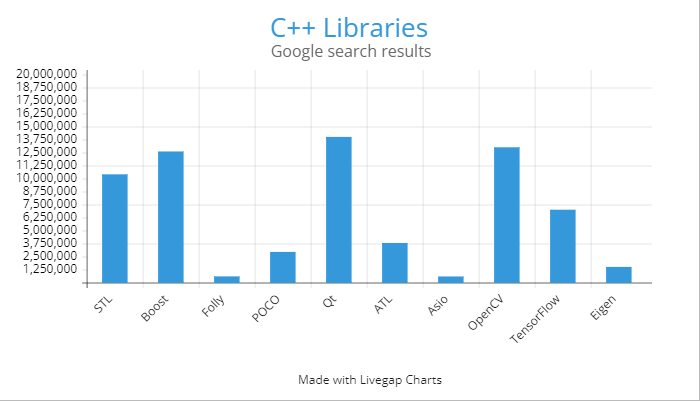
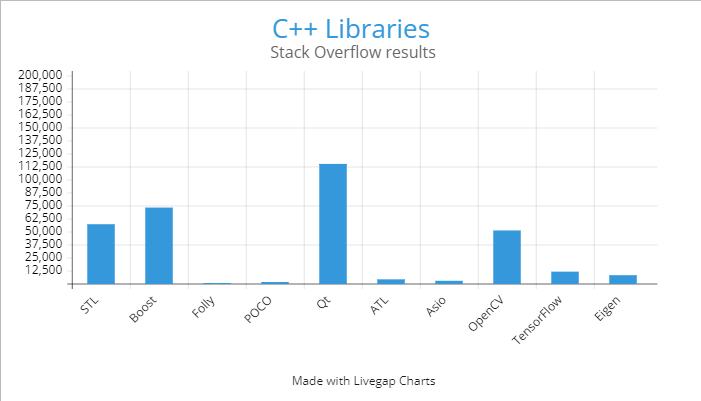
We selected these libraries by looking at Google and Stack Overflow search results, as well as C++ repositories on GitHub and other open-source C++ projects.
Google search results:
Stack Overflow question results:
If you're a beginner, we recommend mastering the STL first. Then, depending on your specific needs, you can choose one of the libraries on this list: