

RosettaStone Earns the CppDepend Gold Code Quality Label
Analyzed with CppDepend v2026.2 — October 2026 · github.com/utilForever/RosettaStone
RosettaStone is a high-performance, open-source C++23 Hearthstone game engine and simulator library. Designed for simulation speed, determinism, and artificial intelligence research (including reinforcement learning and MCTS), it supports both normal play mode and Battlegrounds. The core C++ engine provides clean abstractions for cards, entities, game tasks, triggers, and auras — exposing bindings to Python via pybind11 (pyRosetta) alongside console and developer tooling interfaces.
RosettaStone maintains a strong B technical debt rating even when enforcing strict compliance standards, including MISRA C++.
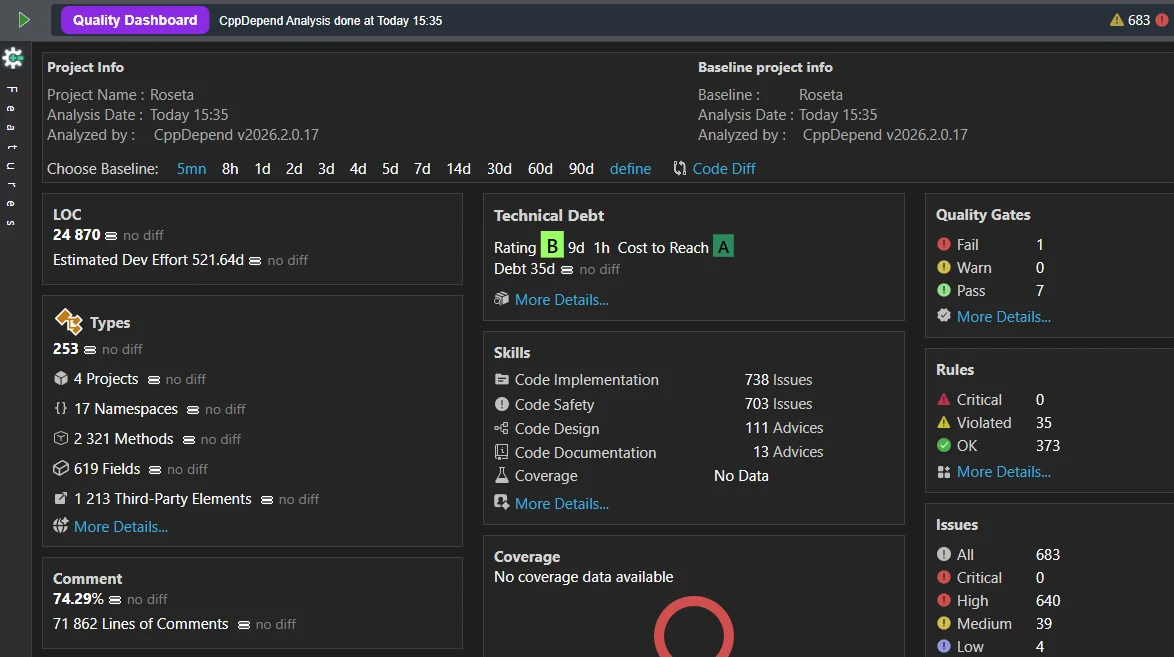
1. Core Metrics Summary
- Project Size & Structure: 24,870 Lines of Code (LOC) representing ~521 days of estimated development effort across 4 projects, 17 namespaces, 253 types, 2,321 methods, and 619 fields — with a strong comment density at 74.29% (71,862 lines of comments).
- Technical Debt: rated B with 35 days of overall debt. Reaching an A rating requires an estimated 9 days and 1 hour of remediation work.
- Quality Gates: 1 failed gate, 0 warnings, and 7 passed gates.
- Rules & Issues: 0 critical rules violated, 35 violated rules out of 373 OK rules, and 683 total issues (640 high priority, 39 medium, 4 low, 0 critical).
2. Architectural Integrity & Code Quality
Simulating complex, event-driven game logic with high performance requires strict architectural discipline. To ensure zero-regression engine updates, clean modular boundaries, and manageable complexity across thousands of card implementations, RosettaStone has a clean design, verified by CppDepend's Dependency Structure Matrix (DSM):
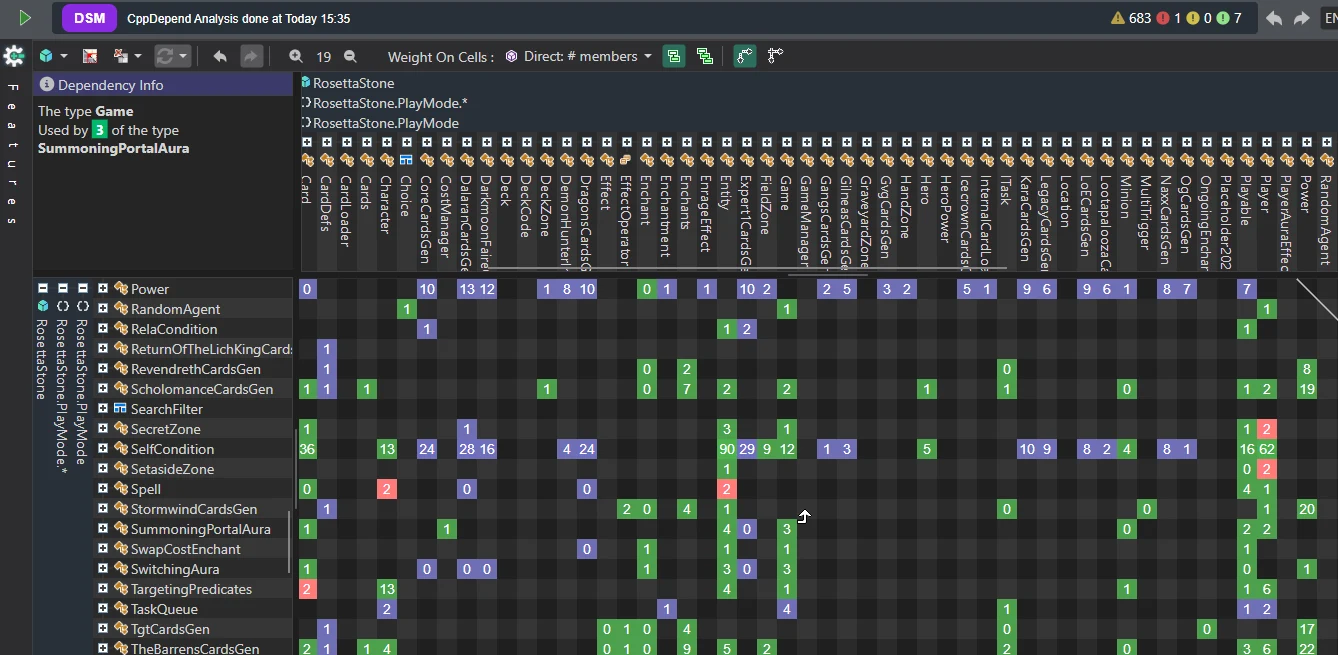
- Triangular Matrix Structure: the matrix forms a near-perfect lower-triangular pattern, confirming a strictly layered architecture with minimal architectural coupling.
- Low Dependency Cycles: the project exhibits virtually zero red cycle indicators, ensuring modules remain decoupled, easy to test, and maintainable.
- High Cohesion: strong encapsulation across core C++ game tasks, card loaders, and Python bindings prevents unexpected side effects across component boundaries.
Celebrating the Community Behind RosettaStone
Achieving high code quality across a complex game engine codebase — thousands of card implementations, deterministic simulation logic and Python bindings — doesn't happen by accident. A huge shout-out to the core contributors, maintainers, and open-source developers whose continuous work, refactoring, and code reviews keep RosettaStone's architecture clean, modular, and maintainable:
Thank you to the entire RosettaStone community for setting a high standard in modern C++ game engine development!
Does your project meet the Gold Standard?
Analyze your codebase with CppDepend and see how it scores on quality gates, technical debt and architecture — like RosettaStone did.