
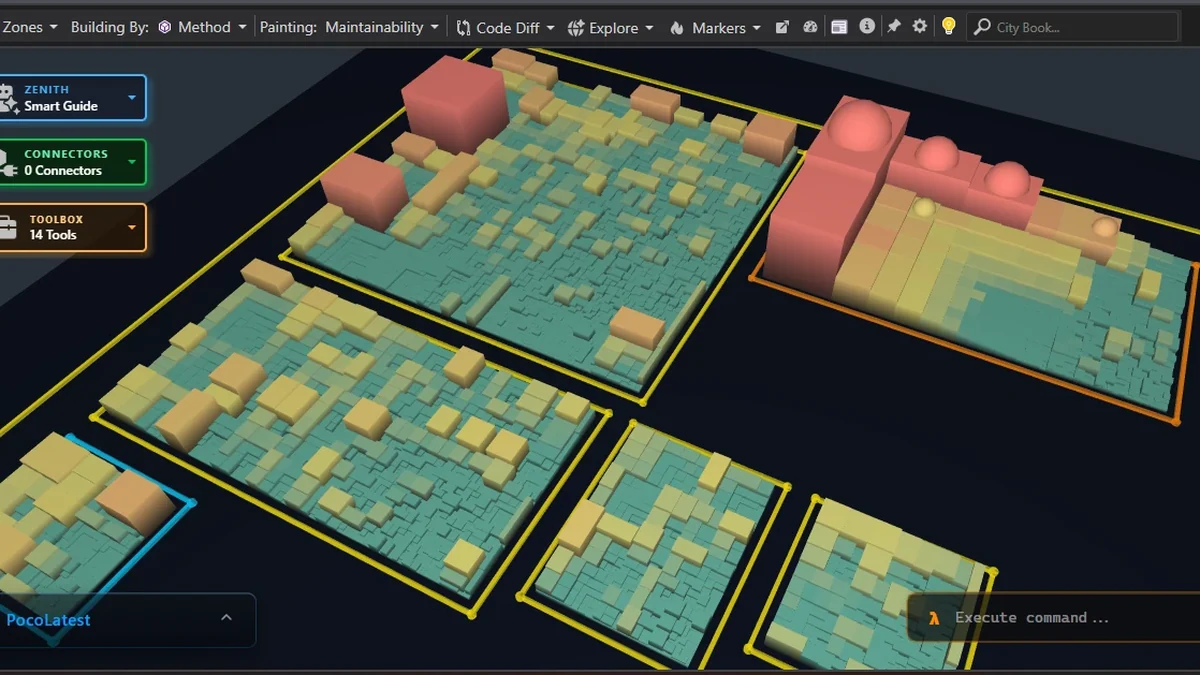
Having had the privilege of connecting with Günter Obiltschnig, the creator of the POCO C++ Libraries, a few years ago, we integrated POCO as a core component of our product ecosystem ever since.
Because POCO continuously evolves to meet new C++ standards and developer requirements, it serves as the ultimate real-world benchmark for our static analysis engine. In fact, POCO is part of the standard CppDepend battery test suite, helping us continuously validate and refine our static analysis rules, dependency metrics, and visualization tools against a massive, production-grade C++ codebase.
In this deep dive, we put POCO under the CppDepend microscope to explore its architectural health, examine how its lean abstract interfaces support maintainability, and visualize how a mature framework continues to evolve without taking on technical debt.
Code City Overview: A Visual Summary of POCO's Quality
The 3D Code City visualization provides a bird's-eye view of the entire POCO codebase:
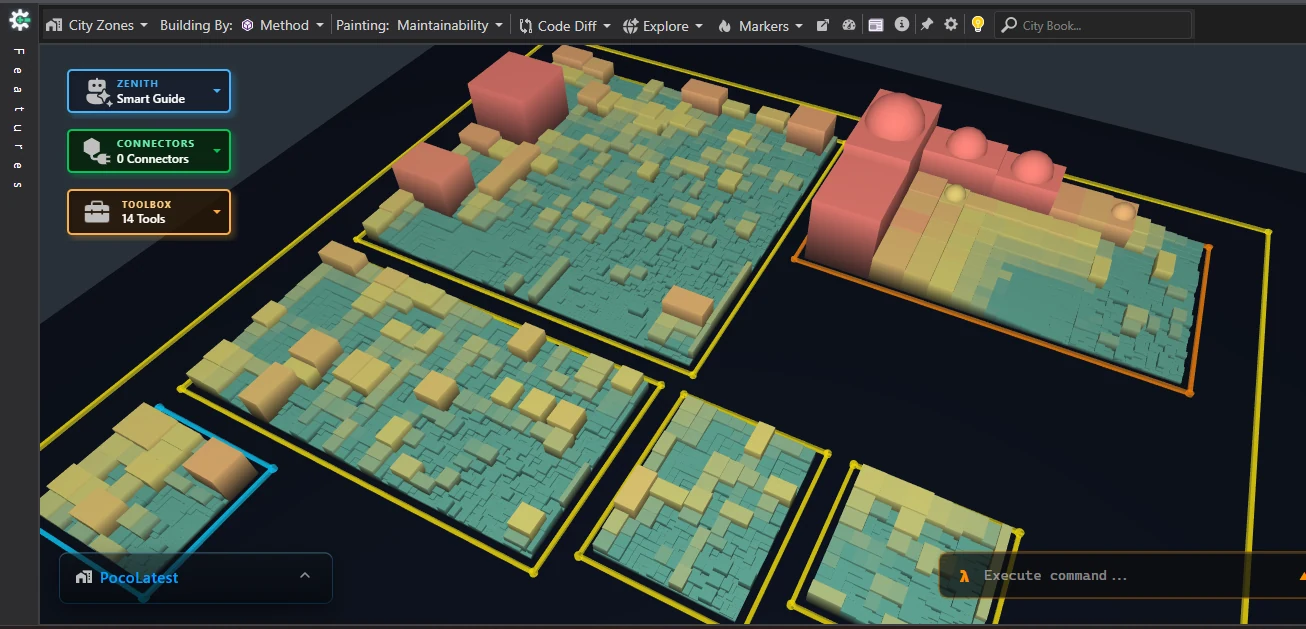
- Building By: Method (each building represents an individual method)
- Painting By: Maintainability & Issues Detected (colors map from green for healthy code to orange/red for code with a low maintainability index or static analysis rule violations)
🟩 Green / Teal ➜ High Maintainability & Zero Issues
🟧 Orange / Red ➜ Low Maintainability Index / Detected Rule Issues
Key Takeaways
- Overall Codebase Health is High: The vast majority of the city consists of flat green and teal buildings, proving that POCO's overall architecture is clean, highly maintainable, and largely free of critical violations.
- Issues are Highly Isolated: Only a handful of methods appear as tall orange or red blocks. These represent the few specific methods that suffer from lower maintainability or trigger static analysis rules.
- Targeted Refactoring: Instead of spending time analyzing thousands of lines of healthy code, team leaders and developers can immediately focus their refactoring efforts on just these few flagged methods.
Structural Architecture: Clean Layering with Foundation at the Core
Beyond method-level quality, POCO's high-level architecture stands out for its exemplary modularization and strict dependency layering, as revealed by the Dependency Structure Matrix (DSM):
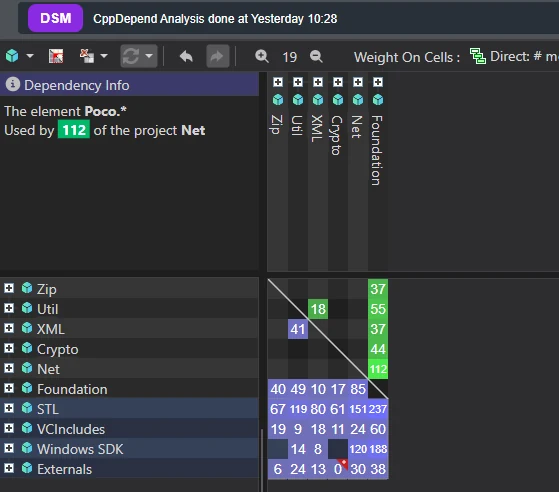
- Triangular Matrix Pattern: Notice how almost all cell values sit above the diagonal line (green cells) or under the system libraries area. This indicates a clean, acyclic dependency graph without structural dependency cycles between high-level components.
- Foundation as the Universal Base: The rightmost column shows a bright green streak across projects like Zip, Util, XML, Crypto, and Net. Every higher-level library depends heavily on Foundation (e.g., Net uses Foundation 112 times, Util uses it 55 times), while Foundation itself depends on none of them.
- Strict Separation of Concerns: Core modules stay completely decoupled from one another. For instance, Crypto and Net do not directly depend on XML or Zip, keeping component boundaries clean and allowing developers to use only the specific POCO libraries they need.
Why This Architecture Wins
- Zero High-Level Cyclic Dependencies: By keeping dependencies flowing strictly downward toward Foundation, POCO eliminates cyclic links, preventing build times from cascading across modules.
- High Reusability: Because base modules like Foundation remain pure and free of upward dependencies, they can easily be reused across different projects or embedded systems without pulling in unused code.
- Painless Upgrades & Maintenance: Changes within higher-level modules (such as XML or Net) are completely isolated and won't destabilize other sibling components in the framework.
Object-Oriented Design: Lean Abstractions and Strong Single Responsibility
A key sign of a well-architected framework is how it handles abstraction. By executing a CQLinq query to inspect abstract classes across the solution (from t in Types where t.IsAbstract select new { t, t.NbMethods }), we uncover a disciplined design pattern:
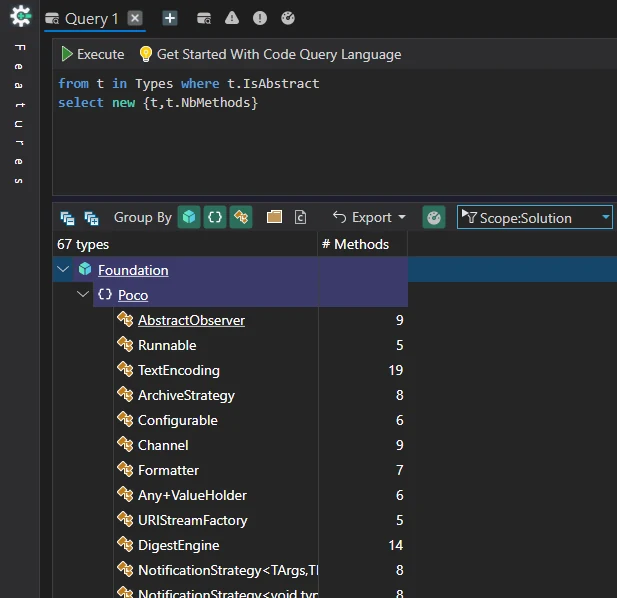
- Extensive Use of Abstraction: POCO relies heavily on abstract contracts (e.g., Runnable, Channel, Formatter, DigestEngine, TextEncoding) to decouple interfaces from implementation details.
- Low Method Counts per Interface: Unlike bloated interfaces found in some large frameworks, POCO's abstract classes remain concise and focused. Most classes declare only a small set of methods—often between 5 and 19 methods (for example, Runnable with 5, Configurable with 6, Channel with 9, and DigestEngine with 14).
Why This Demonstrates Great Responsibility Design
- Adherence to Single Responsibility Principle (SRP): Each abstract class defines a tightly scoped role (e.g., handling formatting, stream strategy, or logging output) rather than acting as a catch-all "god class".
- Interface Segregation (ISP): Keeping abstract classes compact ensures derived classes are only forced to implement methods directly relevant to their specific contract.
- Ease of Extension & Maintenance: Lightweight abstract contracts make it simple for developers using POCO to extend or implement custom providers without taking on unnecessary implementation overhead.
Perpetual Evolution: Continuous Refinement Across Versions
A mature library isn't static—it continuously adapts, refactors, and expands to meet modern C++ standards and developer needs. Performing a Code Diff analysis between versions highlights POCO's active lifecycle and ongoing engineering efforts:
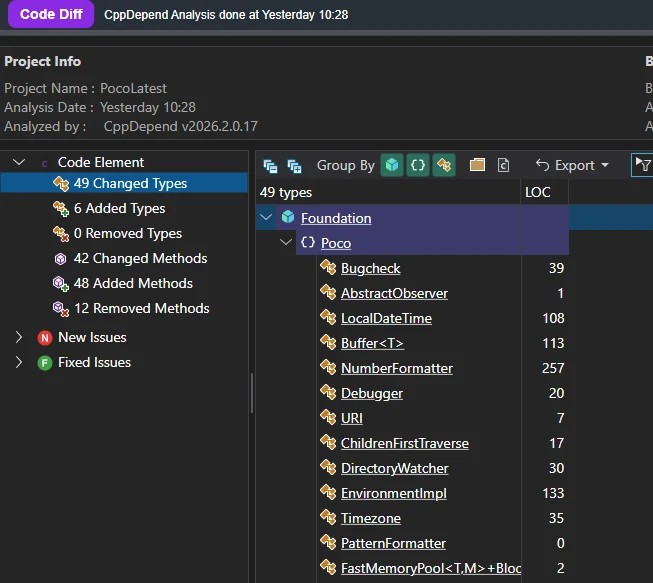
- Active Feature Expansion: Recent changes show 6 Added Types and 48 Added Methods, indicating active development of new capabilities across foundational modules like Foundation.
- Code Refactoring & Modernization: With 49 Changed Types, 42 Changed Methods, and 12 Removed Methods, the maintainers are actively polishing existing algorithms, updating signatures, and deprecating redundant logic rather than simply appending code.
- Controlled & Non-Breaking Evolution: Notice that while types and methods are being added and refactored, 0 Types were removed, preserving backward compatibility for existing applications built on top of POCO.
What This Means for Engineering Teams
- Active Maintainability: Continuous refactoring ensures the framework avoids accumulating technical debt over time.
- Backward Compatibility: Modernization occurs without introducing breaking API changes, allowing projects to safely upgrade POCO versions.
- Future-Proof Infrastructure: Ongoing updates across core components like LocalDateTime, Buffer<T>, and DirectoryWatcher ensure POCO remains a robust foundation for C++ applications.
Visualizing Evolution in 3D: Mapping Code Diff to the Code City
While tabular diff data provides exact counts, rendering version changes in a 3D Code City gives an immediate, spatial view of where code changes are concentrated across the architecture.
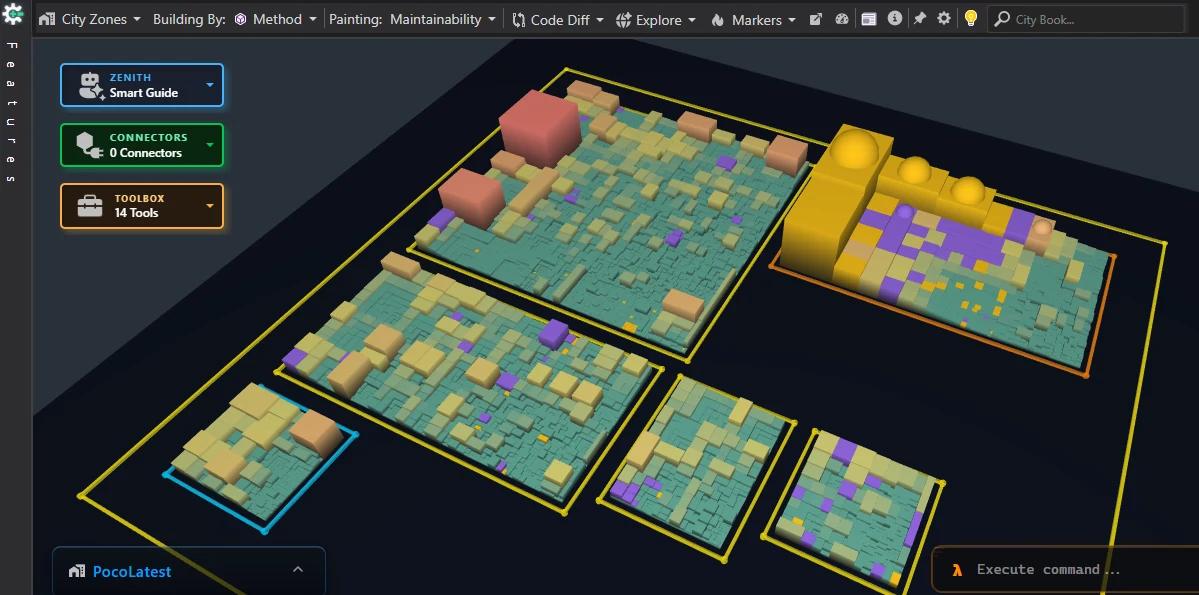
By applying the Code Diff painting mode in CppDepend, methods are color-coded based on their status between builds:
- Gold Buildings (New Methods): Bright gold structures represent brand-new methods added in the latest release. Their distribution reveals where new capabilities and feature additions are actively growing within specific modules.
- Violet Buildings (Modified Methods): Purple/violet buildings highlight existing methods that underwent refactoring, bug fixes, or signature updates.
- Green / Neutral Buildings (Unchanged Code): The steady green foundation reflects stable, untouched logic that continues to form the core of the framework.
Architectural Takeaways from the City View
- Targeted Refactoring: Rather than chaotic changes spread everywhere, modified methods (violet) appear in localized clusters, demonstrating controlled and intentional maintenance.
- Modular Expansion: New features (gold) fit seamlessly alongside existing components without cluttering or destabilizing surrounding architecture.
- Visual Balance: The dominance of green building blocks highlights that POCO preserves a vast, stable foundation across upgrades, protecting dependent applications from unnecessary disruption.
Conclusion: A Masterclass in Modern C++ Engineering
Analyzing POCO C++ Libraries through static analysis and dependency metrics reveals why it remains a benchmark for C++ framework design:
- Visual Health: The 3D Code City confirms that POCO's codebase is overwhelmingly clean, with potential maintainability concerns and rule violations strictly isolated to a small handful of methods.
- Clean Architecture: The Dependency Structure Matrix demonstrates exemplary modularity, keeping components decoupled while relying on Foundation as a rock-solid, acyclic core.
- Disciplined Abstraction: With compact abstract classes adhering strictly to single responsibility, POCO offers high extensibility without unnecessary interface bloat.
- Continuous Evolution: Code Diff tracking shows a living codebase—actively expanding features and modernizing existing code while preserving essential backward compatibility.
For C++ developers, architects, and engineering leads, POCO stands as a textbook example of how disciplined object-oriented design, modular architecture, and active maintenance can sustain a robust, production-grade library over the long haul.