
In modern software engineering, developers are often taught to stick rigidly to a single language paradigm: pure Object-Oriented C++, strict functional programming, or monolithic C APIs.
The extraordinary success of llama.cpp proves a different thesis: Pragmatism beats dogma.
Instead of forcing a uniform design pattern across the entire project, llama.cpp is built as a layered hierarchy where every tier is deliberately engineered with the paradigm best suited to its specific problem domain—ranging from low-level C memory arenas up to modern C++ abstractions.
Let's analyze llama using CppDepend and explore the overall code quality of llama.cpp:
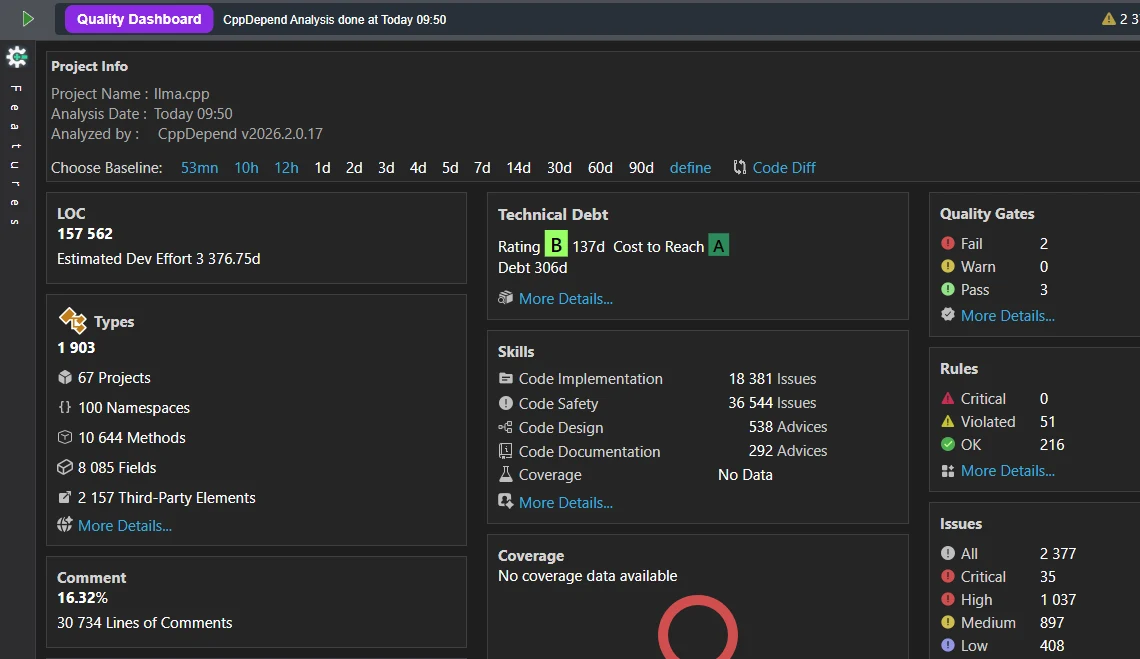
The project achieves a B Rating for overall code quality and technical debt, demonstrating a well-structured architecture with relatively low technical debt density.
1. Exploring llama.cpp as Code City
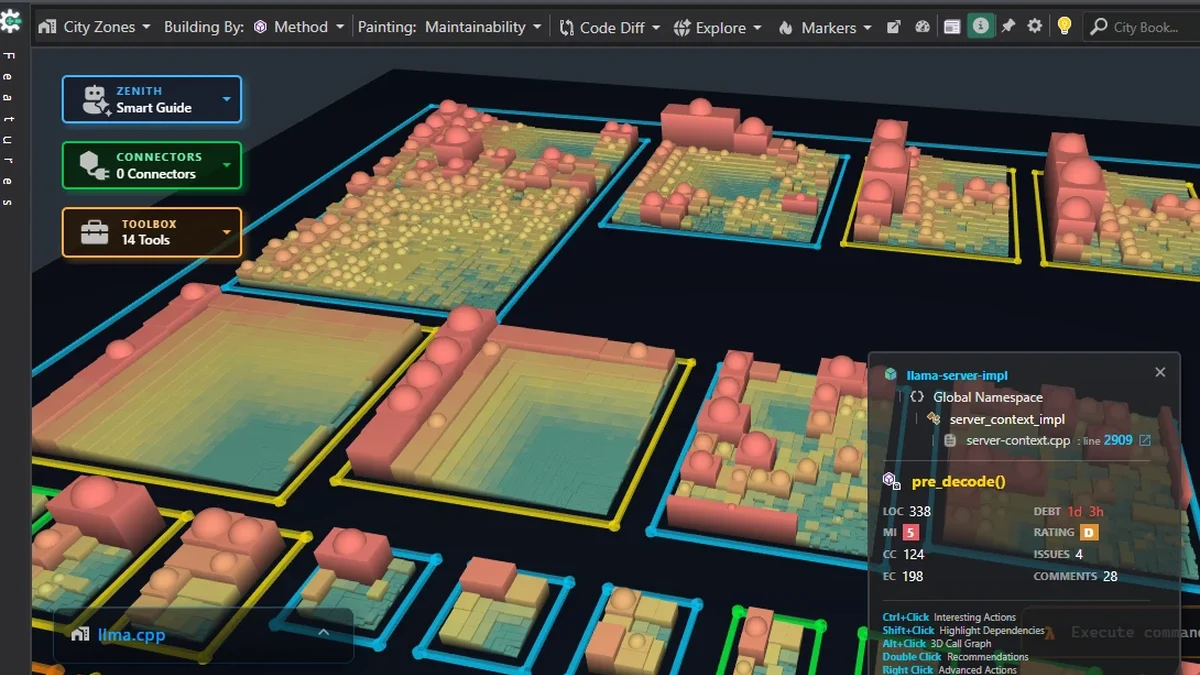
After evaluating the summary dashboard, we can visually explore where the code can be improved using the Code City feature. Visualizing the codebase as a 3D Code City provides immediate visual insights into coupling, hotspots, code smells, method sizes, and issue distributions.
In this Code City, each building represents the methods, while the color indicates health and issue severity. Hovering over any building yields detailed diagnostic metrics.
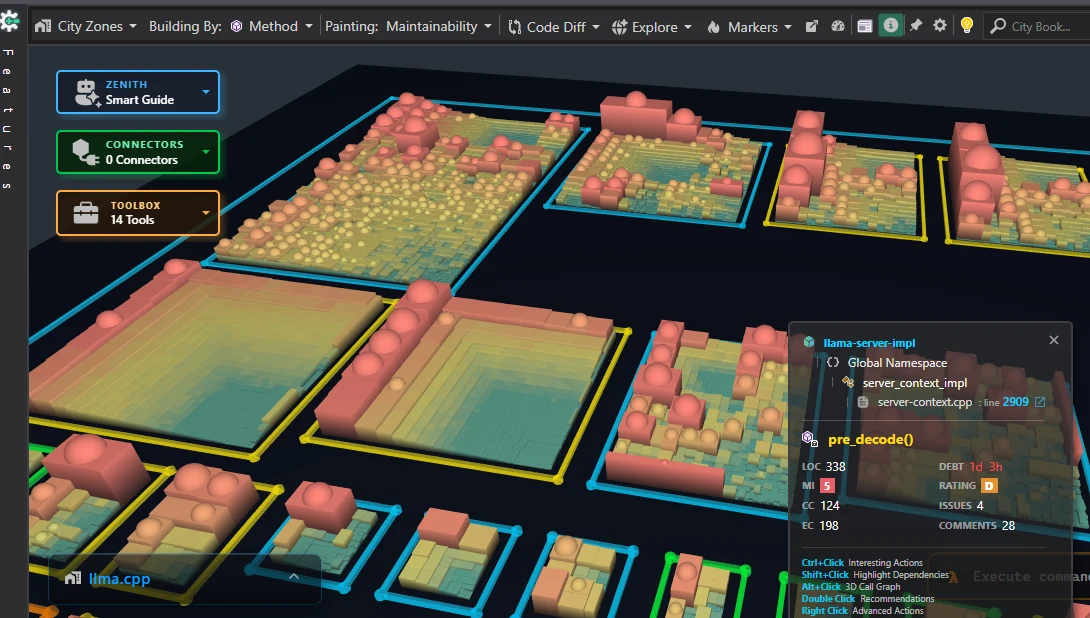
While many methods are highlighted in red, a closer look reveals that they are generally code smells. As the Issues Explorer shows, many code smells are detected:
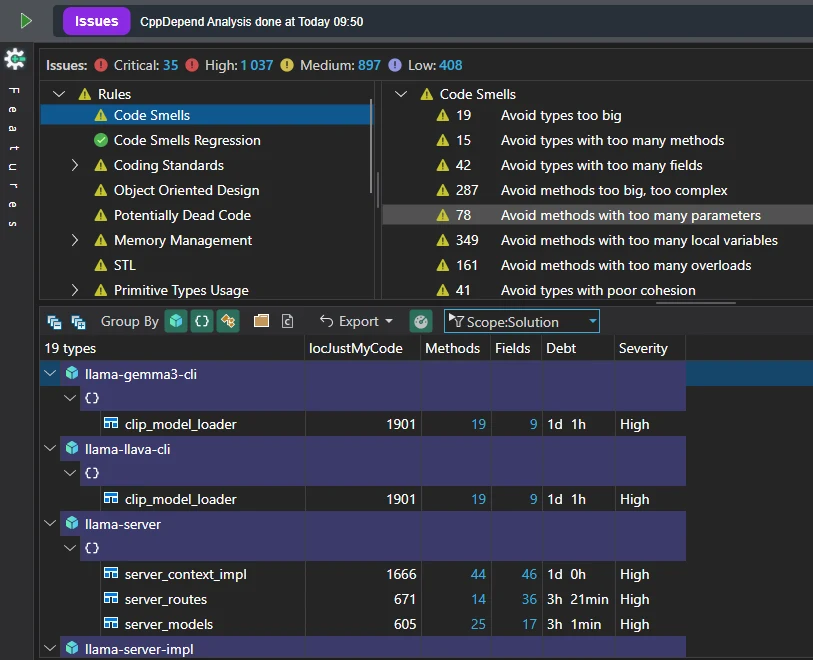
Here are a few reasons why these functions trigger code smell warnings, even when the design is intentional:
1.1. Inlining and Cache Locality (Avoiding Function Call Overhead)
In low-level SIMD and matrix math kernels, splitting a 500-line loop into 10 smaller helper functions destroys execution efficiency:
- Register Spilling & Instruction Overhead: Function calls push registers onto the stack and create jump instructions. Inside tight loops executing billions of times per second (such as inner quantized GEMM loops), function call overhead degrades performance significantly.
- Instruction Cache Line Hits: A single, monolithic loop keeps hot execution instructions continuous inside the CPU's Instruction Cache (I-Cache) or GPU shared memory, preventing pipeline stalls.
1.2. Massive Model Support via Centralized Dispatch
llama.cpp supports dozens of model architectures (Llama, Mistral, Gemma, Mixtral, DeepSeek, Command R) inside monolithic graph construction functions (e.g., llama_build_graph).
- Exhaustive Architecture Switch Blocks: Rather than using complex C++ object-oriented inheritance hierarchies (e.g.,
class LlamaModel : public ModelBase), llama.cpp uses huge switch statements over model architecture enums. - Trade-off: Static analyzers flag these as "Brain Methods" or "God Functions" because of their sheer size, but this procedural layout keeps graph node construction completely transparent and visible in one continuous block of code.
1.3. Quantization Type Explosion (ggml_type Switch Loops)
A single math operation (like tensor multiplication) must handle combinations of F32, F16, Q4_0, Q4_K_M, Q8_0, IQ3_XXS, and more.
// Common pattern triggering complexity warnings in GGML
switch (tensor->type) {
case GGML_TYPE_Q4_0: /* SIMD unroll for Q4_0 */ break;
case GGML_TYPE_Q4_K: /* SIMD unroll for Q4_K */ break;
case GGML_TYPE_Q8_0: /* SIMD unroll for Q8_0 */ break;
// ... 20+ quantization types unrolled directly in line
}
Because each quantization type has its own block layout and vector-dequantization math, these loops contain massive nested blocks that spike Cyclomatic Complexity metrics.
1.4. Rapid Open-Source Evolution ("Hacker C" Culture)
llama.cpp evolved from a single-file C++ proof-of-concept into a massive community project:
- Speed of Feature Integration: When a new paper or model architecture drops (e.g., custom RoPE embeddings or expert routing in MoE), contributors add execution branches directly into existing graph-building functions.
- Pragmatism Over Abstraction: The project intentionally prioritizes raw execution speed and ease of single-file modification over strict OOP design patterns.
2. llama.cpp: The Art of Using GRASP Patterns
llama.cpp applies GRASP (General Responsibility Assignment Software Patterns) principles across discrete workspace modules, isolating core responsibilities while avoiding tight runtime coupling.
2.1. High-Level Modular Decomposition (GRASP Scope)
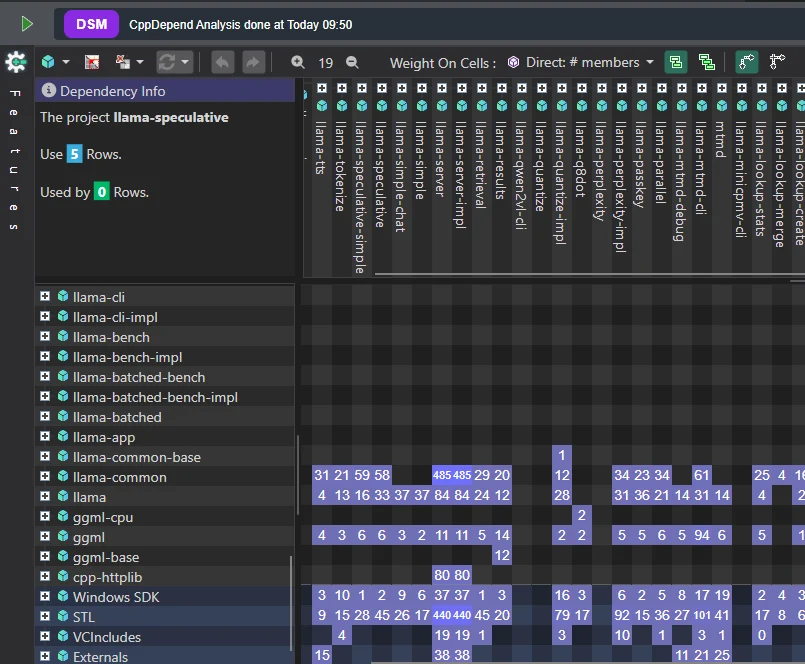
Instead of building a massive monolithic executable, the project splits functionalities across distinct modules:
2.2. How GRASP Principles Drive the Decoupling
High Cohesion & Single Responsibility (SRP)
- ggml (Tensor Runtime): Dedicated solely to tensor structures (
ggml_tensor), memory allocation arenas, computation graph building (ggml_cgraph), and backend orchestration. It has zero awareness of LLM transformers, tokenization, or prompt formatting. - libllama (include/llama.h, src/llama.cpp): Manages transformer mechanics, GGUF file loading, KV cache allocation, and sequence sampling. It delegates matrix math entirely down to ggml.
- common (llama-common / common/): Encapsulates cross-cutting CLI utilities, argument parsing, console logging, CPU affinity, benchmarking, and speculative execution logic. Core engine consumers can link against libllama directly without taking dependencies on common.
Information Expert
- Hardware Backends (ggml-cuda, ggml-metal, ggml-vulkan): Each backend acts as the sole expert for executing tensor operations on its hardware target. Hardware details never leak into llama.cpp or high-level application code.
Protected Variations & Low Coupling
- The Pure C API Boundary (include/llama.h): High-level applications interact with the engine exclusively through C-style handles (
llama_model*,llama_context*). This creates an architectural firewall: the entire internal implementation of llama.cpp can be refactored without breaking downstream tools or bindings (Python, Node.js, Rust).
2.3. Dependency Matrix Insight: The "Block Diagonal" Pattern
When evaluating this multi-project setup in a Dependency Structure Matrix (DSM):
- Clean Block Isolation: The matrix renders as distinct diagonal blocks corresponding to ggml, llama, and common.
- No Unwanted Cross-Talk: ggml components never reference llama.cpp or common. llama components depend on ggml but remain completely unaware of high-level CLI code.
- Pluggable Architecture: You can strip out common/ and tools/ and link libllama directly into an embedded runtime or desktop application with minimal footprint.
3. Quantifying Codebase Abstraction
Abstract types are widely used in modern C++ to achieve clean, decoupling-focused designs, but is that the case for llama.cpp? Let's search for abstract types across the codebase using this query:
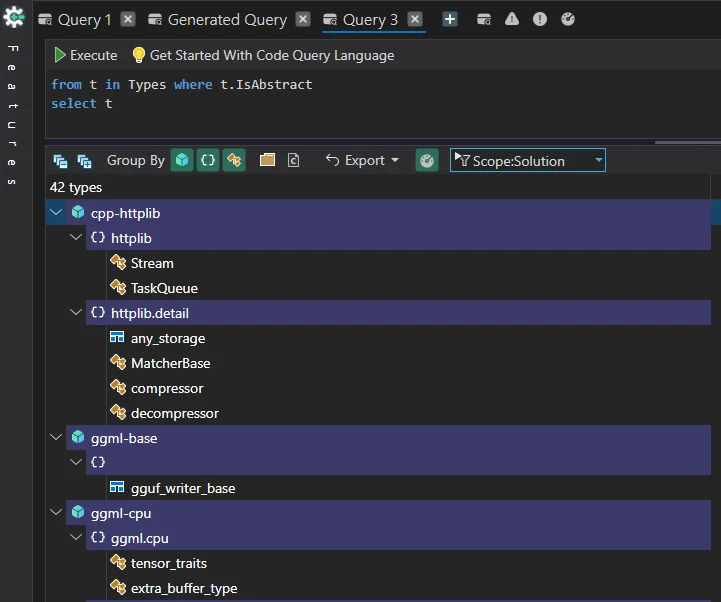
Only few types are abstract and llama.cpp deliberately avoids classic Object-Oriented Programming (OOP) paradigms like abstract base classes, dynamic dispatch (virtual functions), and heavy inheritance hierarchies.
This design choice comes down to four core engineering trade-offs:
3.1. Eliminating Vtable Penalties & Indirection
In high-performance C++, virtual function calls require looking up function pointers in a virtual table (vtable).
- Cache Misses & Pointer Chasing: In a deep tensor graph execution loop, making thousands of virtual calls per second introduces branch mispredictions and forces CPU pipelines to stall.
- Inlining Blockers: The compiler often cannot inline a virtual method call because the concrete type isn't known at compile time. By using plain C structs, explicit function pointers, or static templates, the compiler can inline code directly into raw assembly loop iterations.
3.2. Predictable Memory Layouts over Polymorphic Pointer Storage
Abstract classes force you to work with pointers or smart pointers (std::unique_ptr<ITensor>) to support dynamic dispatch.
- Pointers lead to heap allocations (malloc/new), resulting in fragmented memory across the heap.
- ggml (the underlying tensor engine) relies on flat, contiguous bump-allocated arenas (
ggml_context). Memory offsets are pre-planned into a single static graph layout before execution starts. Standard OOP abstractions shatter contiguous memory layouts, destroying L1/L2 cache locality.
3.3. ABI Stability Across C / Foreign Language Bindings
llama.cpp is meant to run everywhere—embedded in Python (llama-cpp-python), Rust, Go, Swift, C#, and Node.js.
- Modern C++ class hierarchies with virtual tables have compiler-mangled symbol names that differ between GCC, Clang, and MSVC.
- By using flat C-style structs (
struct llama_model,struct llama_context) and C functions (llama_decode()), llama.cpp exposes a clean C ABI boundary. Any language can consume a standard C header without needing a complex C++ runtime wrapper.
3.4. Simple Compute Graph Architecture vs. Object Graphs
In standard software applications, polymorphism models business entities (e.g., class Dog : public Animal). In LLM inference engines, the domain model consists of Static Compute Graphs and Tensors:
- A model architecture is represented as a sequence of tensor math nodes (
ggml_mul_mat,ggml_add), not a deep tree of objects. - Variations between backends (CUDA, Metal, Vulkan, CPU SIMD) are handled via static backend dispatches, enum flags, or compile-time execution pipelines, rather than polymorphic runtime wrappers around every operation.
Summary Architectural Trade-off
| Design Pattern | OOP / Abstract Classes | llama.cpp C-Style / Procedural |
|---|---|---|
| Dispatch Mechanism | Dynamic (Vtable lookups) | Static / Direct C-function dispatch |
| Memory Allocation | Heap pointers (new/malloc) | Contiguous pre-allocated Arena (ggml_context) |
| Compiler Optimization | Limited (Virtual calls block inlining) | Maximum (Hot SIMD loops inlined easily) |
| Language Interop | Difficult (Requires complex C++ bindings) | Trivial (Exposes standard C ABI) |
4. Using POD Types in the Llama Model
POD (Plain Old Data) types in C++ are simple, C-compatible data structures that hold data without additional modern C++ object-oriented overhead.
Let's search for the POD types used in llama.cpp using this code query:
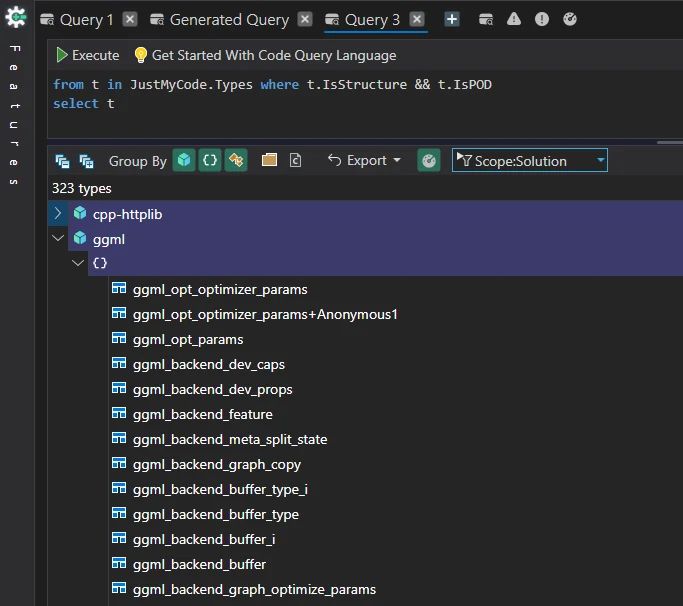
Here is why llama.cpp uses simple POD structs everywhere:
4.1. Predictable C-Compatible Memory Layouts
A POD struct in C++ has a contiguous, deterministic memory footprint with no hidden compiler-inserted pointers (like a vptr used for virtual functions).
- Direct Serialization/Deserialization: When loading GGUF model files, POD structures allow reading raw bytes straight from disk into memory (fread or mmap) directly into the struct without needing complex parsing, constructors, or object allocations.
- C ABI Compatibility: POD structs map 1:1 to standard C data structures. This allows non-C++ languages (Python, Rust, Go, Swift, C#) to map the exact same struct layout in memory without marshalling overhead.
4.2. Extreme Cache Locality (L1/L2 Cache Efficiency)
Modern CPUs run thousands of times faster than main RAM. Performance in LLM inference relies heavily on keeping CPU/GPU pipelines fed with data.
- Contiguous Arrays: Because POD types have no hidden overhead or heap pointers inside them, they can be packed tightly into flat, contiguous arrays (
std::vector<llama_token_data>or raw memory arenas). - Sequential Cache Prefetching: When iterating over a contiguous array of POD structs during token sampling or KV-cache management, the hardware prefetcher effortlessly loads the next elements into L1/L2 cache before the loop even requests them.
4.3. Compatible with Custom Arena Allocators (ggml)
Standard C++ objects with non-trivial constructors/destructors require new and delete, which allocate memory dynamically across the heap.
- Heap allocations cause memory fragmentation and unpredictable allocation latency.
- llama.cpp uses bump/arena allocators via
ggml_context. Raw memory is reserved once as a huge chunk, and POD structs are placed directly into this pre-allocated memory offset. Because PODs do not require destructors, reclaiming or resetting memory is as fast as resetting a single pointer back to zero (offset = 0).
4.4. Zero Run-Time Overhead & Trivial Copying
POD structs have no hidden logic running behind the scenes:
- Copying or moving a POD struct is just a fast memory copy operation (memcpy).
- Passing POD structs by value or const reference introduces zero hidden copy-constructor or destructor calls, giving the developer complete control over execution performance in hot inner loops.
5. Standard Template Library (STL) Footprint and Usage
To see where and how the STL is used, we can analyze the Dependency Matrix for a detailed view of its usage across the codebase.
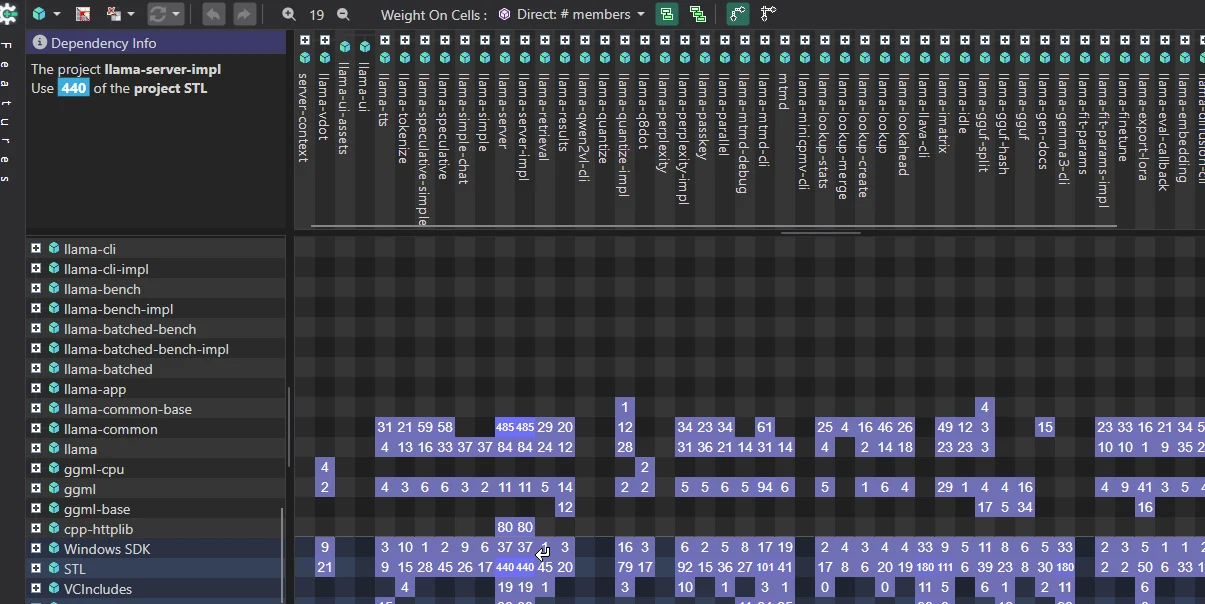
As we can see, the STL is heavily used in higher-level modules, while low-level modules use it rarely—if at all.
5.1. llama-server: Complex Orchestration Requires High-Level Abstractions
llama-server is an HTTP API daemon that handles multi-threading, asynchronous I/O, slot management, JSON parsing, queueing, and HTTP state.
It heavily leverages standard library features (std::*) because writing network orchestration code in low-level procedural C/C++ is impractical:
- Concurrency & Synchronization:
std::thread,std::mutex,std::condition_variable,std::future, andstd::atomicmanage incoming web requests and queue inference tasks. - Complex Data Structures:
std::unordered_map,std::queue,std::map, andstd::vectorhandle multi-tenant session slots, context state, and token sequences. - String Processing & Formatting:
std::string,std::stringstream, and regex operations format JSON inputs/outputs for OpenAI-compatible REST endpoints.
5.2. Core Engines (ggml & llama): STL Avoidance for Raw Performance
In contrast, low-level inference code in ggml and core llama avoids deep STL usage for performance-critical reasons:
- Avoiding Non-Deterministic Allocation: Containers like
std::vectororstd::stringallocate and reallocate memory on the heap dynamically (malloc/free). In hot tensor matrix-multiplication loops, dynamic allocations trigger OS system calls and introduce tail-latency spikes. ggml uses static pre-allocated memory arenas (ggml_context) instead. - Binary Size & Compilation Speed: Heavy C++ STL template expansion (
<iostream>,<regex>,<algorithm>) drastically inflates binary sizes and slows down compile times. Keeping core compute files minimal allows fast compilation on embedded systems and light micro-runtimes. - Maximum Portability & Bare-Metal Execution: ggml runs on resource-constrained platforms, WASM (web browsers), microcontrollers, and custom hardware accelerators where a full C++ standard runtime environment might be stripped down, missing, or inefficient.
6. Exception Usage
Core C++ exceptions are strictly avoided in the inner compute layers (ggml and llama), though exceptions do appear in higher-level helper wrappers (llama-common, common/arg.cpp, and llama-server).
Let's discover which modules use the std::exception class using this code query:
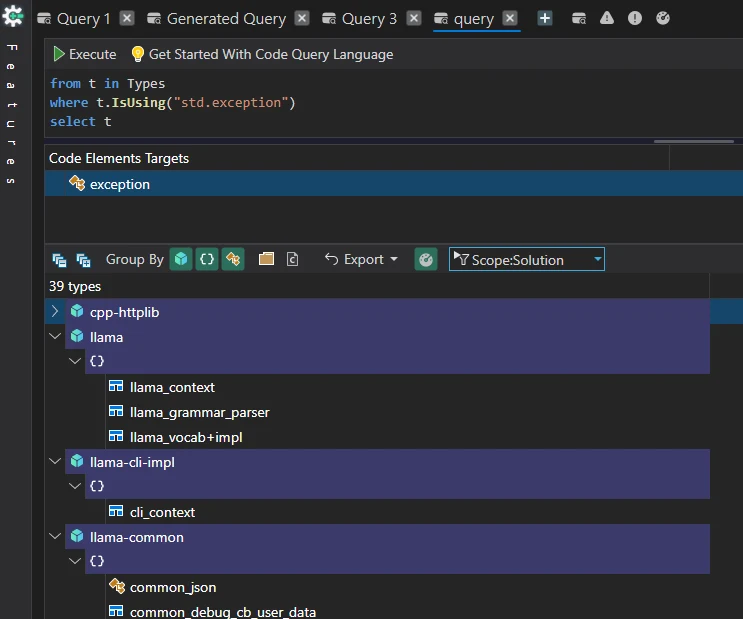
llama.cpp follows a strict split in how it handles errors across its architecture:
6.1. ggml & Core llama: C-Style Error Codes & Assertions
In the foundation layers, exception handling is intentionally omitted:
- Return Codes & Null Pointers: Methods like
llama_decode(),llama_model_load(), or internal allocation routines return nullptr, integer error status codes (0, -1), or boolean flags instead of throwingstd::exception. - Explicit Assertions: Unrecoverable invariant checks (such as mismatched tensor dimensions or out-of-bounds context execution) use macro assertions (
GGML_ASSERT/assert()) that immediately abort or log errors safely rather than unwinding the stack. - C ABI Boundary Safety: The primary public API exposed by llama.h is a C ABI. Throwing C++ exceptions across a C language boundary is undefined behavior in C++, so the core functions must not let exceptions escape.
6.2. High-Level Wrappers (llama-common & llama-server): Selective C++ Exceptions
Exceptions appear in higher-level tooling for developer convenience:
- CLI Argument Parsing (arg.cpp): Throws
std::runtime_errororstd::invalid_argumentwhen parsing command-line parameters (e.g., malformed flag options or missing model paths). - Server & Third-Party Libraries (llama-server): Consumes libraries like nlohmann::json or HTTP parsers that naturally throw exceptions during bad payload parsing. These are caught inside try/catch blocks at the top level of the server loop.
Why Core Inference Avoids Exceptions
- Zero Stack Unwinding Overhead: Enabling exceptions (-fexceptions) introduces binary code bloat and hidden control-flow paths. Disabling or avoiding exceptions in hot loops keeps SIMD execution pipelines and compiler optimizations aggressive.
- Deterministic Control Flow: LLM matrix operations and memory arenas (
ggml_context) require explicit cleanup. A thrown exception can easily bypass non-RAII custom arena destructors, leading to massive GPU/CPU memory leaks. - Cross-Language Safety: Language bindings (Python, Rust, C#, Go) expect simple C-style return codes to map exceptions cleanly within their own native language runtimes.
7. Namespace Usage
In modern C++, namespaces are scope boundaries used to organize code into logical groups and prevent name collisions across libraries.
Let's explore if namespaces are widely used in llama.cpp:
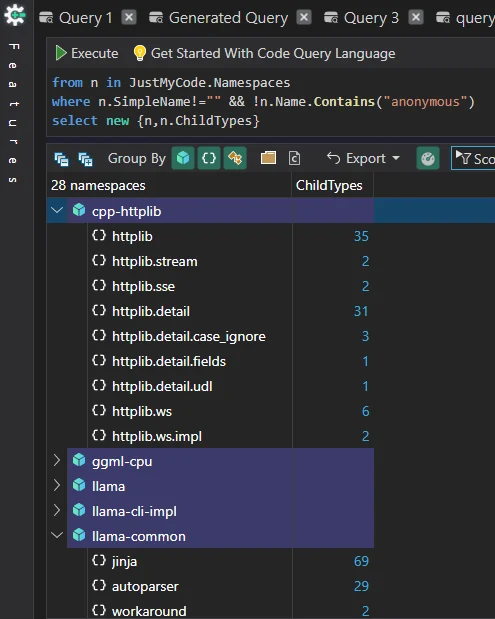
Namespaces are prominent in cpp-httplib and llama-common, but virtually absent from the remaining libraries. Here are a few reasons for this pattern:
7.1. The Core Engine (ggml) is Pure C
The foundation of llama.cpp is the ggml tensor evaluation library. ggml is written in standard C (C99/C11) to ensure portable runtime execution across hardware backends (CPU, CUDA, Metal, Vulkan, OpenCL).
- Since C does not support namespaces, ggml uses explicit
ggml_prefixes for functions and structs (e.g.,ggml_init,ggml_tensor,ggml_cgraph) to isolate symbols without needing C++ namespaces.
7.2. ABI Stability & C-API Compatibility
One of llama.cpp's primary design goals is to serve as an embeddable, light engine for bindings in other languages (Python, Rust, Go, Java, Swift, C#).
- C++ Name Mangling: C++ namespaces alter exported symbol names at compile time.
- To expose clean, unmangled symbols that work seamlessly with dlopen and C FFI wrappers, core headers export plain C ABIs (
extern "C"). Avoiding deep namespace hierarchies simplifies exporting shared library boundaries (llama.h, ggml.h).
7.3. C-Style Data Structures and POD Types
llama.cpp prioritizes POD (Plain Old Data) structs, static functions, and explicit function signatures over object-oriented C++ hierarchies.
- Code isolation is managed via compilation units (file-scope static functions) inside .cpp files rather than wrapping components in nested
namespace llama { namespace detail { ... } }blocks. - This keeps global namespace pollution low while preserving direct memory control and static visibility within individual implementation files.
7.4. Minimalist "Zero-Overhead C++" Philosophy
llama.cpp follows a minimalist variant of C++ often described as "C with Classes" or "Data-Oriented C++".
- The codebase selectively uses standard C++ features (like
std::vector,std::string, orstd::thread) to simplify memory management and concurrency, while avoiding deeply nested namespaces, heavy template metaprogramming, or complex class inheritance hierarchies.
8. Template Usage
In C++, generic programming via templates enables writing reusable, type-safe algorithms and data structures without runtime performance penalties. By generating code at compile time, templates eliminate indirection, allow deep compiler inlining, and optimize performance directly for concrete types.
Let's explore if templates are defined in llama.cpp:
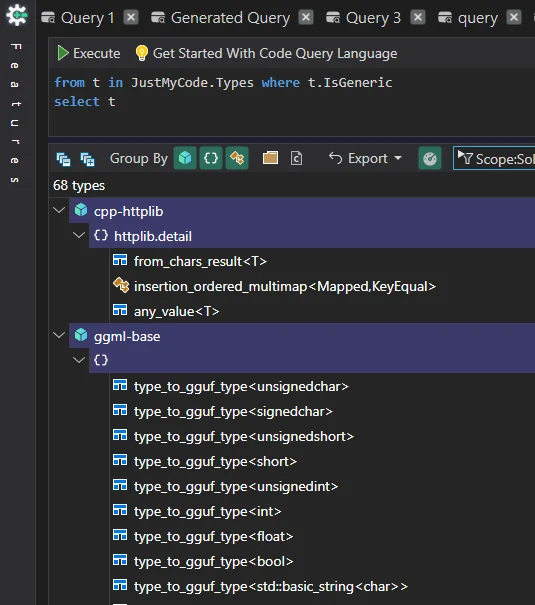
And to visually explore where the templates are defined, we can export the query result to the treemap view:
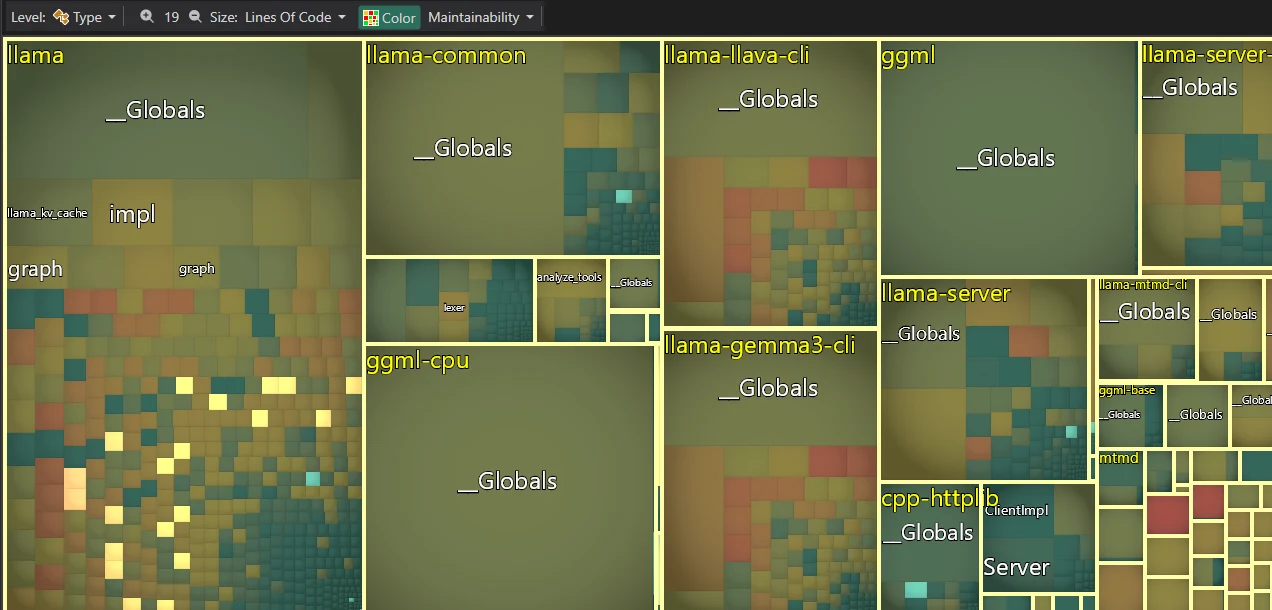
The concerned types are highlighted, and as shown in the treemap they are defined in a few libraries, especially the llama library.
Instead of relying on template-heavy C++ generics, llama.cpp chooses C-style procedural code, dynamic dispatch via enums (ggml_type), and macros for specific engineering reasons:
8.1. Eliminating Template Code Bloat (Binary Size Inflation)
When you instantiate C++ templates across multiple data types (e.g., float, fp16, int8, int4), the compiler generates a separate copy of the machine code for every type permutation.
- Instruction Cache Misses: Duplicate template-instantiated functions bloat the final binary executable size. Large binaries strain the CPU's instruction cache (I-Cache), causing cache misses that slow down execution loops.
- Procedural Code Sharing: ggml uses explicit enum dispatch (
switch (type)) to share single implementation entry points rather than inflating the code segment with templated functions.
8.2. Drastic Reduction in Compilation Time
Heavy C++ template metaprogramming severely increases build times because headers must be parsed, expanded, and compiled repeatedly across translation units.
- By using flat C structs (
struct ggml_tensor), basic enum flags (GGML_TYPE_F32,GGML_TYPE_Q4_0), and plain C headers, llama.cpp compiles in seconds—even on slow devices like a Raspberry Pi or low-spec laptop—whereas heavily templated C++ libraries (like PyTorch C++ or Eigen) can take 20+ minutes to build.
8.3. Dynamic Runtime Typing vs. Static Compile-Time Generics
In Machine Learning runtimes, tensor data types, dimensions, and execution graphs are often determined at runtime (e.g., loading a GGUF model with mixed Q4_K_M and Q8_0 quantizations).
- C++ templates require types to be fixed at compile time.
- If ggml relied on C++ generics for tensor types, every model type combination would need to be pre-compiled into huge template matrices, or the code would have to resort to massive template expansion blocks.
- Using a runtime type enum (
ggml_tensor->type = GGML_TYPE_Q4_K) allows a single, uniform C structure to represent any tensor type dynamically in memory without template parameters.
8.4. Simplified GPU & SIMD Accelerator Backends
llama.cpp offloads tensor computations across diverse hardware backends (CUDA, Metal, Vulkan, OpenCL, AVX-512, ARM NEON).
- Writing device kernels for GPUs or raw SIMD intrinsics requires fine-grained control over low-level assembly layout, memory alignment, and register usage.
- Abstracting inner SIMD/GPU loops behind complex C++ generic templates makes it significantly harder to inspect generated assembly, debug vector alignment issues, or optimize hardware-specific SIMD registers.
Summary Architectural Contrast
| Feature | Generic Templates (template<typename T>) | llama.cpp Dynamic Enums (ggml_type) |
|---|---|---|
| Type Decision | Compile-Time | Run-Time |
| Binary Size | Expands per type (Bloated) | Single procedural implementation (Lean) |
| Compile Speed | Slow (Heavy header parsing) | Extremely Fast |
| Hardware Introspection | Obscured by abstraction layers | Direct C / SIMD register control |
9. Some Facts About the Design Choices
9.1. Types with Too Many Methods
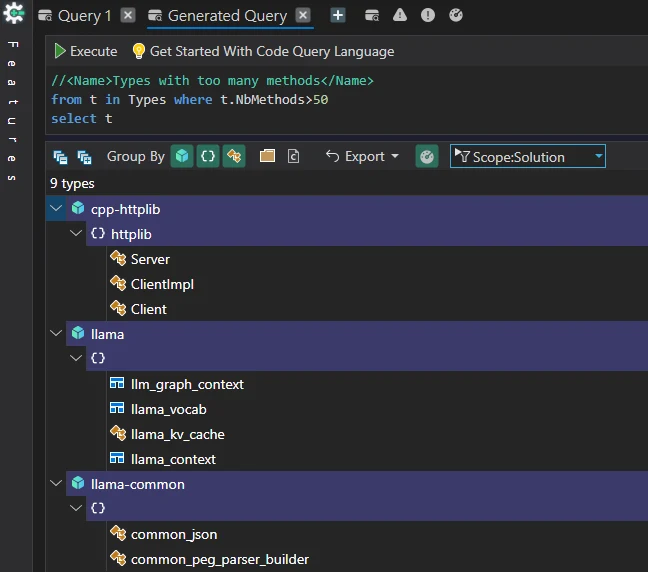
A few types have a large number of methods, but in llama.cpp, each case has a valid engineering reason. For example, here is why such types are expected in an HTTP library:
- Self-Contained Header-Only Architecture: cpp-httplib is intentionally designed as a single-header HTTP library for easy cross-platform embedding. To keep third-party integration simple and avoid complex dependency graphs, protocol features are encapsulated directly within main client and server abstractions.
- Fluent & Developer-Friendly API: A complete HTTP client or server naturally requires a wide array of methods to handle various request options, headers, timeouts, and callbacks without forcing end-users to wire up separate underlying handler objects.
- Internal Delegate Pattern: httplib::Client delegates its core work to httplib::ClientImpl. While ClientImpl accumulates low-level socket, SSL, and transport logic, this separation cleanly protects the public Client API from internal platform-specific details.
9.2. Not Cohesive Types
Type Cohesion (or Class Cohesion in object-oriented programming) measures how closely related and focused the responsibilities, fields, and methods of a single type are.
Let's explore how many non-cohesive types we have in llama.cpp:
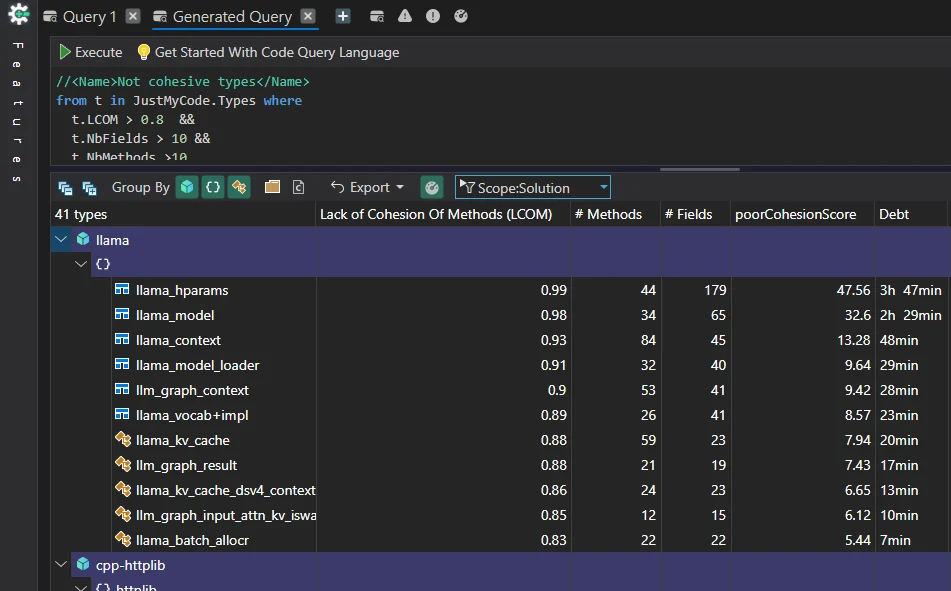
Why Low Cohesion Is Intentional for Some Model Metadata
- POD / DTO Data Pattern:
llama_hparamsacts as a Data Transfer Object (DTO) or C-style struct rather than a stateful object-oriented domain class. Its sole responsibility is holding complete model hyperparameter state parsed from GGUF metadata headers. - Unified Model Architecture Representation: Modern Transformer architectures (Llama, Mistral, Gemma, Qwen) require an extensive array of configuration flags. Grouping these settings inside a single unified hyperparameter struct guarantees that tensor allocation routines, KV cache calculators, and execution graphs receive complete model metadata in a single memory block.
- Decoupling Data from Execution Logic: In C/C++ engine design, data structures (
llama_hparams) are kept decoupled from processing algorithms (ggml compute graphs). Forcing OOP-style cohesion rules on passive data structures adds unnecessary abstraction overhead without improving performance or safety.
9.3. Too Big Methods
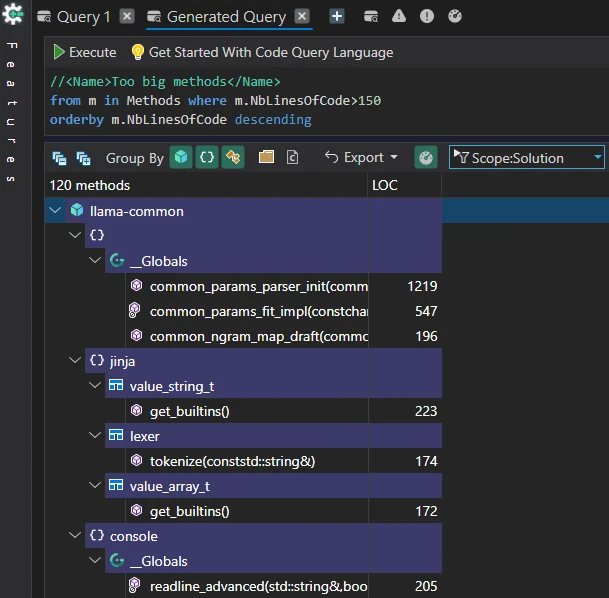
In high-performance C++ codebases like llama.cpp, certain design patterns—such as central configuration dispatchers or massive hardware execution switches—are entirely expected and practical.
Case Study: common_params_parser_init
CppDepend flags common_params_parser_init (located in llama-common) due to its high line count and cyclomatic complexity:
- Why static analysis flags it: It contains dozens of command-line flag definitions, argument parsing blocks, help string formatting rules, and fallback defaults in a single place.
- Why this is normal engineering practice: CLI argument parsers for large ML models natively accumulate hundreds of parameters (
--n-gpu-layers,--ctx-size,--temp,--rope-scaling, etc.). Splitting this initialization into dozens of tiny helper functions would fragment parameter definitions and lower code readability without providing real architectural benefits.
9.4. Not Commented Big Methods
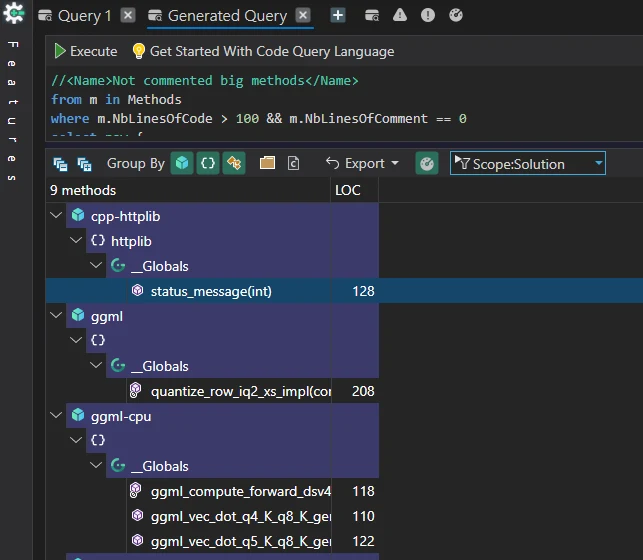
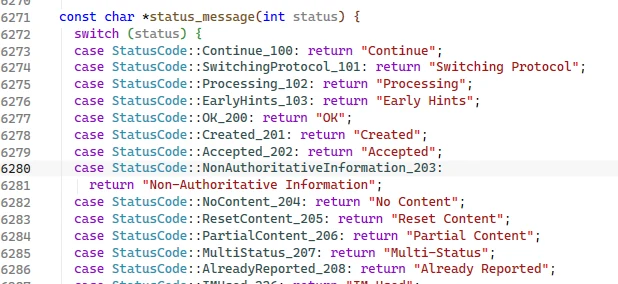
While there are a few large, uncommented methods, a closer look at functions like status_message shows that comments are unnecessary because the code is self-explanatory.
Conclusion: Engineering Beyond the Linter
Analyzing llama.cpp through static code analysis reveals a fascinating duality. At the micro-level, function-length metrics and cyclomatic complexity warnings trigger traditional "code smell" alerts. Yet at the macro-level, the architecture demonstrates exceptional structural discipline—driven by strict layer isolation, zero cyclic dependencies, and clean GRASP-aligned module decoupling.
llama.cpp proves that world-class C++ performance isn't about dogmatically adhering to OOP design patterns or safety-critical linter rules. It's about making intentional engineering trade-offs: sacrificing micro-level elegance inside hot execution paths to achieve maximum instruction cache locality, zero-overhead hardware dispatch, and razor-sharp execution speed.