
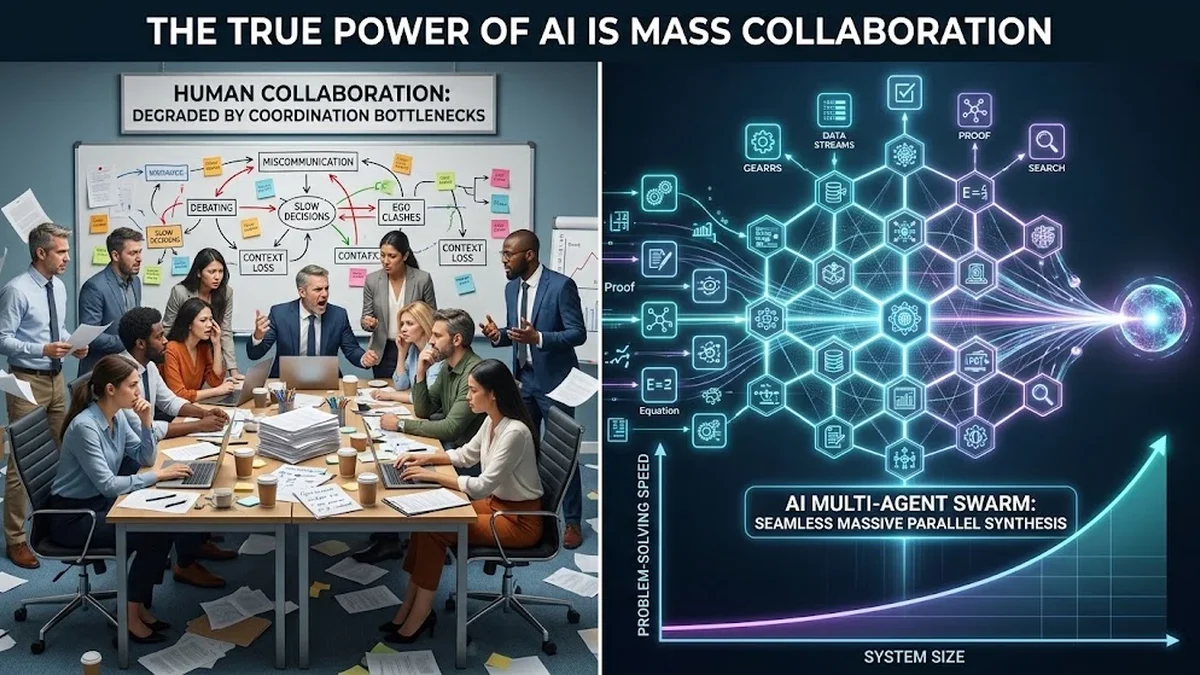
When we discuss artificial intelligence outperforming humans, the conversation usually circles around speed, raw processing power, or memory capacity. But the true game-changer isn't a single hyper-intelligent model—it's multi-agent orchestration.
Human brilliance is fundamentally constrained by communication bottlenecks. Consider what happens when you attempt to scale human intellectual output: if you assemble 10,000 elite human researchers to solve a single, highly complex theoretical problem, productivity doesn't scale linearly—it degrades.
- Quadratic Coordination Overhead: Communication paths explode exponentially with group size (N(N−1)/2). The team spends more energy coordinating than thinking.
- Semantic & Methodological Friction: Months are wasted debating terminology, aligning on foundational assumptions, and agreeing on frameworks.
- Institutional & Personal Silos: Egos, academic turf wars, and slow peer-review pipelines delay cross-pollination of ideas.
- Context Loss: No human can read, absorb, and synthesize thousands of granular observations produced by colleagues in real time.
Human intelligence scales through slow cultural consensus. Autonomous AI agent swarms scale through zero-friction, synchronous collaboration.
Case Study: The 10,000-Agent Swarm vs. Navier-Stokes
To see this dynamic in action, look at OpenAI's deployment of an internal multi-agent architecture against the Navier-Stokes Millennium Prize problem—a fundamental question regarding fluid dynamics that stumped mathematicians for nearly a century.
Rather than relying on a single large model attempting to reason sequentially through a 100-page proof, the system operated as an ultra-dense, autonomous research network:
1. Massively Parallel Exploration
Roughly 10,000 specialized agent instances were spun up concurrently. While one subset of agents explored candidate fluid velocity profiles, another group calculated energy dissipation balances, and another stress-tested boundary conditions. Thousands of potential avenues were evaluated simultaneously.
2. Zero-Friction Message Passing
Over an 88-hour run, the swarm exchanged 2.7 million messages and generated 130 billion output tokens. Unlike human teams that meet weekly to share findings, these agents continuously broadcast intermediate lemmas, invalidation notices, and partial proofs across the network instantly. Dead ends were pruned across the entire swarm in seconds.
3. Formal Algorithmic Verification
Human proofs often contain subtle logical leaps that take years for peer reviewers to catch. In this setup, candidate proof fragments generated by the swarm were constantly validated against formal proof assistants (like Lean). The agents didn't just guess—they mathematically verified their claims in an automated loop.
What would have taken decades of sequential human publishing and debate was compressed into less than four days.
The Shift: From Linear Search to Exponential Coverage
The fundamental limit of human scientific progress has never been individual brainpower; it has always been synchronization speed. Human language, meetings, and reading speeds act as a tight bottleneck on how fast knowledge moves between minds.
Swarm architecture fundamentally alters this equation:
- No Coordination Decay: A network of 10,000 agents communicates at the exact same latency as a network of 2.
- Instant Alignment: The entire collective pivots instantly when a core assumption is disproved.
- Exhaustive State-Space Search: Problems that were previously considered intractable due to their sheer combinatorial width become solvable through sheer parallel coverage.
The future of AI engineering isn't just training a "smarter" chatbot to answer your prompt—it's building orchestrators that can marshal thousands of autonomous agents to solve problems humanity simply cannot coordinate fast enough to answer.
For a deeper look into how the multi-agent system tackled this mathematical problem and how Lean verification was used, check out this overview on OpenAI's Navier-Stokes Millennium Prize Solution. This video breaks down the specific proof architecture and token metrics behind the run.