
Avionics code built for certification — and for 20 years of service.
Coding-standard checks, architecture control and traceable trends for DO-178C programs and defense systems — running fully offline, in your secure lab.
- Supports DO-178C objectives
- MISRA · CERT · CWE built in
- Air-gapped labs
- Windows · Linux · macOS
- UI in 7 languages

Trusted by engineering teams at
Failure is not an option. Neither is a rewrite.
Flight control, radar and navigation software must be verifiable today and maintainable for decades — often in classified environments.
Certification rigor
DO-178C demands verified coding standards, controlled complexity and a traceable architecture.
20-year lifespans
Programs outlive teams. Keep massive legacy codebases understandable and modular.
Strict modularity
Partitioned architectures need enforced boundaries between components and suppliers.
Secure environments
Classified programs need tools that run fully offline, with no data leaving the lab.
Rule sets for mission-critical C and C++
Combine built-in MISRA and CERT rules with your program's own guidelines. Every finding is traced to the exact file and line.
From first analysis to lasting code quality
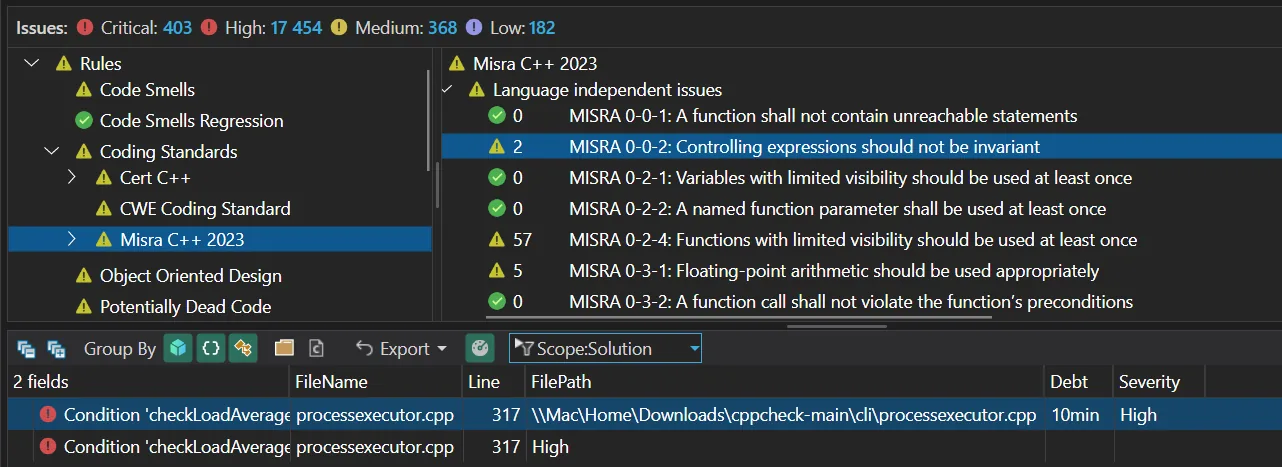
Automate coding-standard verification
Turn manual code-standard reviews into automated, repeatable checks — locally and on every build.
- MISRA and CERT results, traced to the exact line of code
- Separate new violations from the legacy baseline
- Include rule groups in the HTML report for auditors
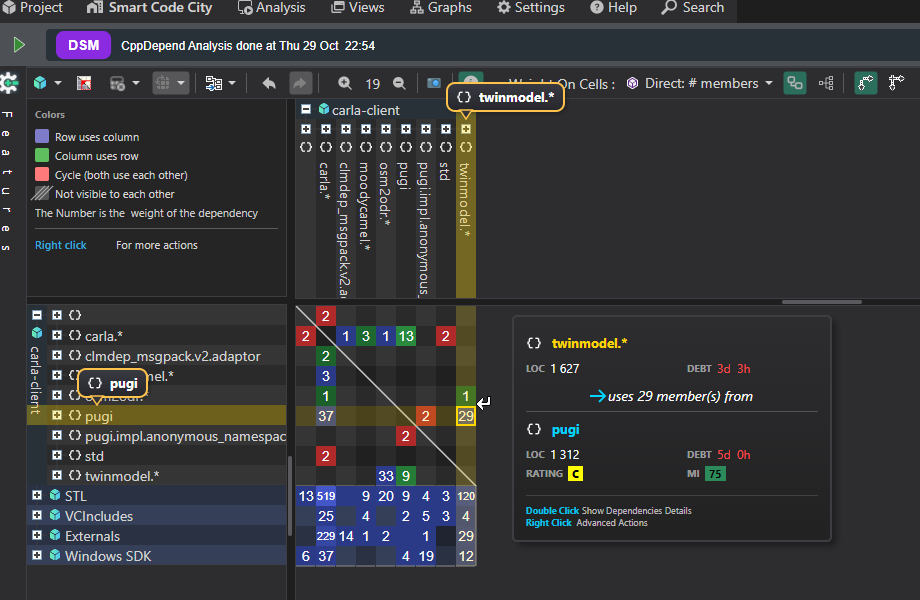
Enforce component boundaries
Visualize every dependency between partitions and components, and stop architectural drift before it compromises the design.
- Dependency matrix and graph across components and namespaces
- Detect cycles and forbidden couplings early
- Architecture rules that run on every build
Encode your program's coding rules
Complexity limits, forbidden constructs and design rules from your program standard — written once as Code Quest rules, checked forever.
- Complexity budgets per criticality level
- Program-specific design and coding rules
- Evidence in reports for internal and external reviews
// Flight control: complexity budget
warnif count > 0
from m in Application.Namespaces
   .WithNameLike("FlightControl").ChildMethods()
where m.CyclomaticComplexity > 10
select new { m, m.CyclomaticComplexity,
             m.NbLinesOfCode }
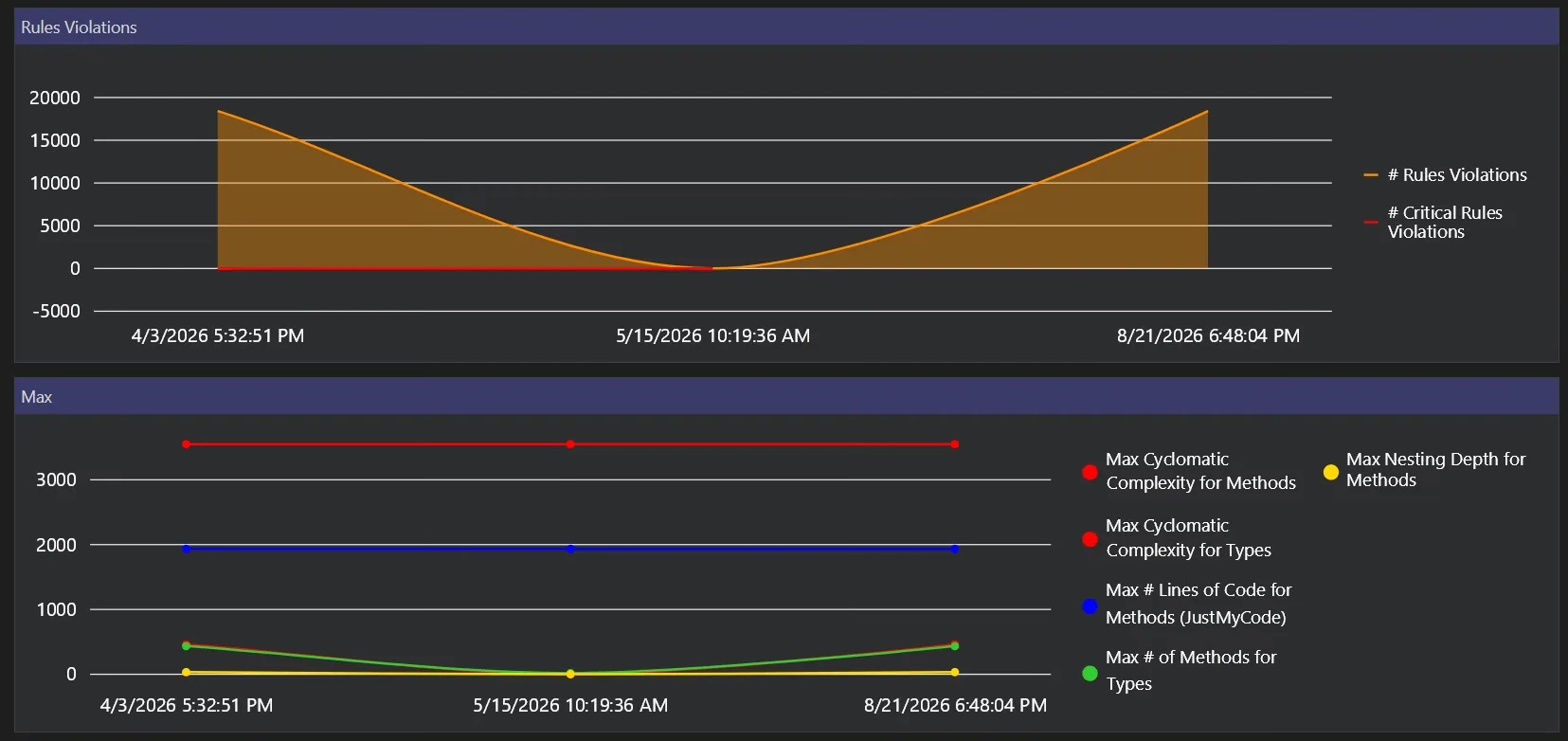
Track every change over the program's life
Trend charts and build comparisons show how quality evolves release after release — ready for reviews and re-certification.
- Compare any two builds: new, fixed and changed issues
- Trend charts for debt, complexity and rule violations
- Shareable reports for reviewers and auditors
No new build system. No workflow change.
CppDepend parses your code with Clang from the build description you already have, and brings findings into the tools your team already uses.
Build inputs
IDEs
Import your analyzers
Your code is your IP. It never leaves your network.
Source code is often your most valuable — and most regulated — asset. CppDepend analyzes it where it lives.
100% on-premiseRuns on your workstations and build servers. No source upload.
Air-gap readyWorks fully offline — ideal for defense, medical and secure labs.
No cloud accountNothing to provision, nothing to approve with your security team.
Helped meet DO-178C objectives A-5, A-6 and A-7 by automating verification of coding standards, complexity and architecture.
A leading aerospace technology company developing next-generation avionics software to DO-178C Level A — the highest assurance level for airborne systems.
Read the full case studyQuestions aerospace teams ask us
Does CppDepend support DO-178C?
CppDepend supports DO-178C verification activities with built-in MISRA and CERT rules, custom Code Quest rules for your program standard, complexity metrics and architecture validation.
Can it run in a classified, air-gapped lab?
Yes. CppDepend runs entirely on your machines, works fully offline and needs no cloud account.
Does our source code ever leave our network?
No. CppDepend runs entirely on your workstations and build servers. It works fully offline and in air-gapped labs — no upload, no cloud account.
Can it analyze our build?
CppDepend parses your code with Clang from your existing build description: Visual Studio solutions, a CMake JSON compilation database, Makefiles, or the Build Monitor, which records the compiler calls of your build.
Which operating systems and languages are supported?
CppDepend runs on Windows, Linux and macOS, and its user interface is available in English, German, French, Spanish, Chinese, Japanese and Korean.
How can we evaluate CppDepend on our code?
Start a 30-day full-featured trial, or request a guided PoC: we run CppDepend on your codebase with you and review the results together.
CppDepend works wherever C and C++ run
Not quite your industry? The same analysis engine serves every kind of C/C++ codebase.
See what CppDepend finds in your avionics code
Analyze your own codebase in minutes — coding standards, architecture and quality gates included.
Full-featured trial · No credit card required · Runs on-premise