
ECU software that passes the audit — and the road test.
MISRA C, MISRA C++ and AUTOSAR C++14 checks, architecture validation and CI quality gates for ECUs, ADAS and vehicle control systems — built for ISO 26262 programs.
- MISRA C · MISRA C++ · AUTOSAR C++14
- ISO 26262 workflows
- Used at Porsche Engineering & Siemens
- Windows · Linux · macOS
- UI in 7 languages
Trusted by engineering teams at
Millions of lines. Zero room for error.
Modern vehicles run on millions of lines of C and C++, spread across suppliers, ECUs and model years. Quality has to be provable, not assumed.
Functional safety
ISO 26262 expects coding guidelines, design rules and verification evidence for every ASIL-relevant component.
AUTOSAR layering
Application, RTE, services and MCAL must stay cleanly separated across suppliers and releases.
Long vehicle lifecycles
Platforms live for a decade or more. Keep legacy ECU code maintainable as features pile up.
Recall risk
A defect that slips into production can mean a recall. Catch design-level problems before integration.
MISRA and AUTOSAR, built in
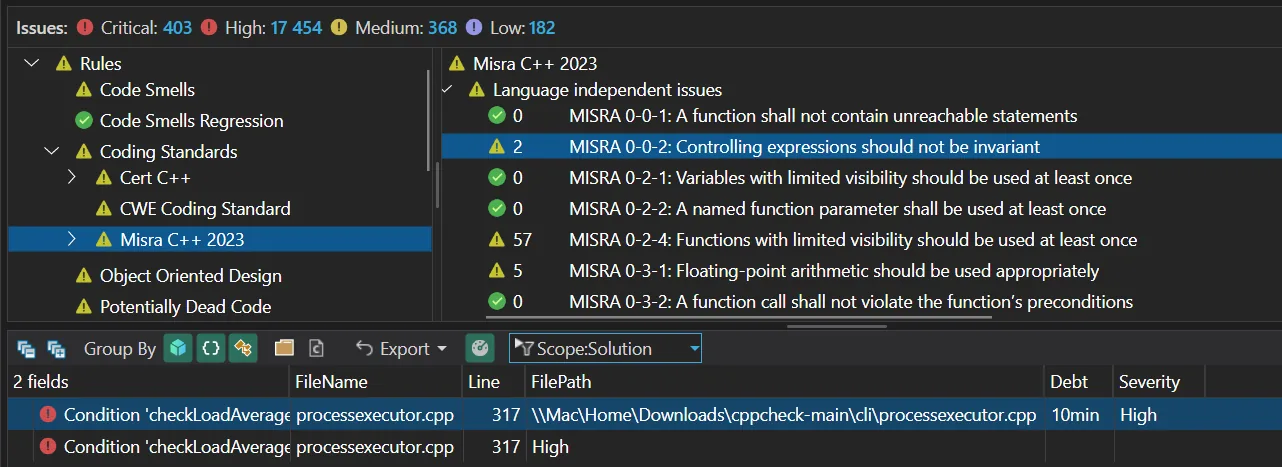
Select MISRA C, MISRA C++ or AUTOSAR C++14 when you create the project. Every violation is traced to the exact file and line.
From first analysis to lasting code quality
Prove MISRA and AUTOSAR compliance on every commit
Run the checks on every pull request and release, and focus engineers on new violations instead of re-reviewing the legacy baseline.
- MISRA and AUTOSAR results, traced to the exact line of code
- Separate new violations from the legacy baseline
- Include rule groups in the HTML report for auditors
Keep the AUTOSAR layers clean
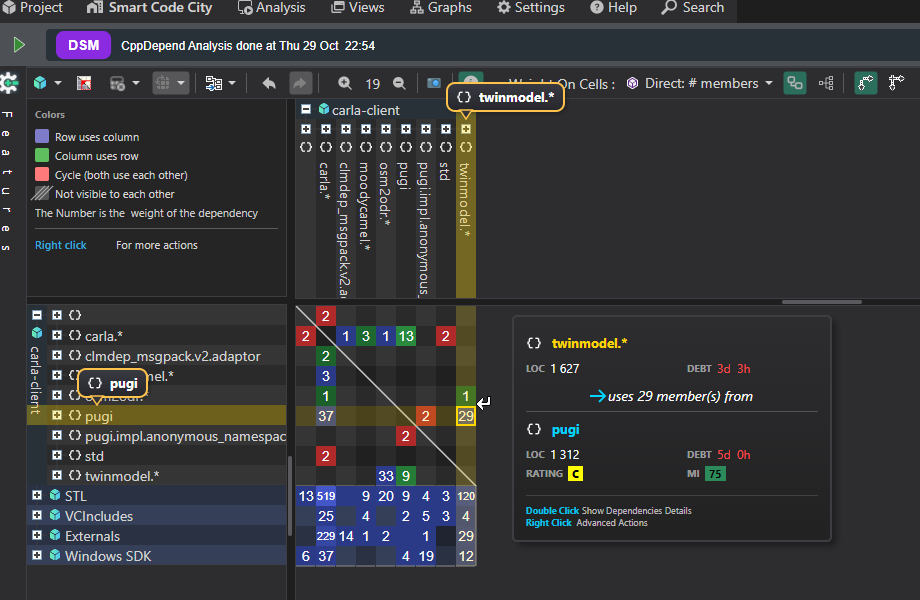
See every coupling between software components at a glance — and catch application code that reaches past the RTE into drivers.
- Dependency matrix and graph across components and namespaces
- Detect cyclic dependencies between ECUs' software modules
- Turn your layering into rules that run on every build
Write rules for your platform
Your OEM and internal guidelines go beyond MISRA. Express them as Code Quest rules and enforce them like built-in ones.
- Forbid direct access from application code to MCAL
- Complexity budgets for safety-relevant functions
- Results in the IDE, in reports and in quality gates
// App code must not call MCAL drivers
warnif count > 0
let upper = Application.Namespaces
   .WithNameLike("App").ChildMethods()
let lower = Application.Namespaces
   .WithNameLike("Mcal").ChildMethods()
from m in upper
where m.IsUsing(lower)
select new { m }
Gate every build before integration
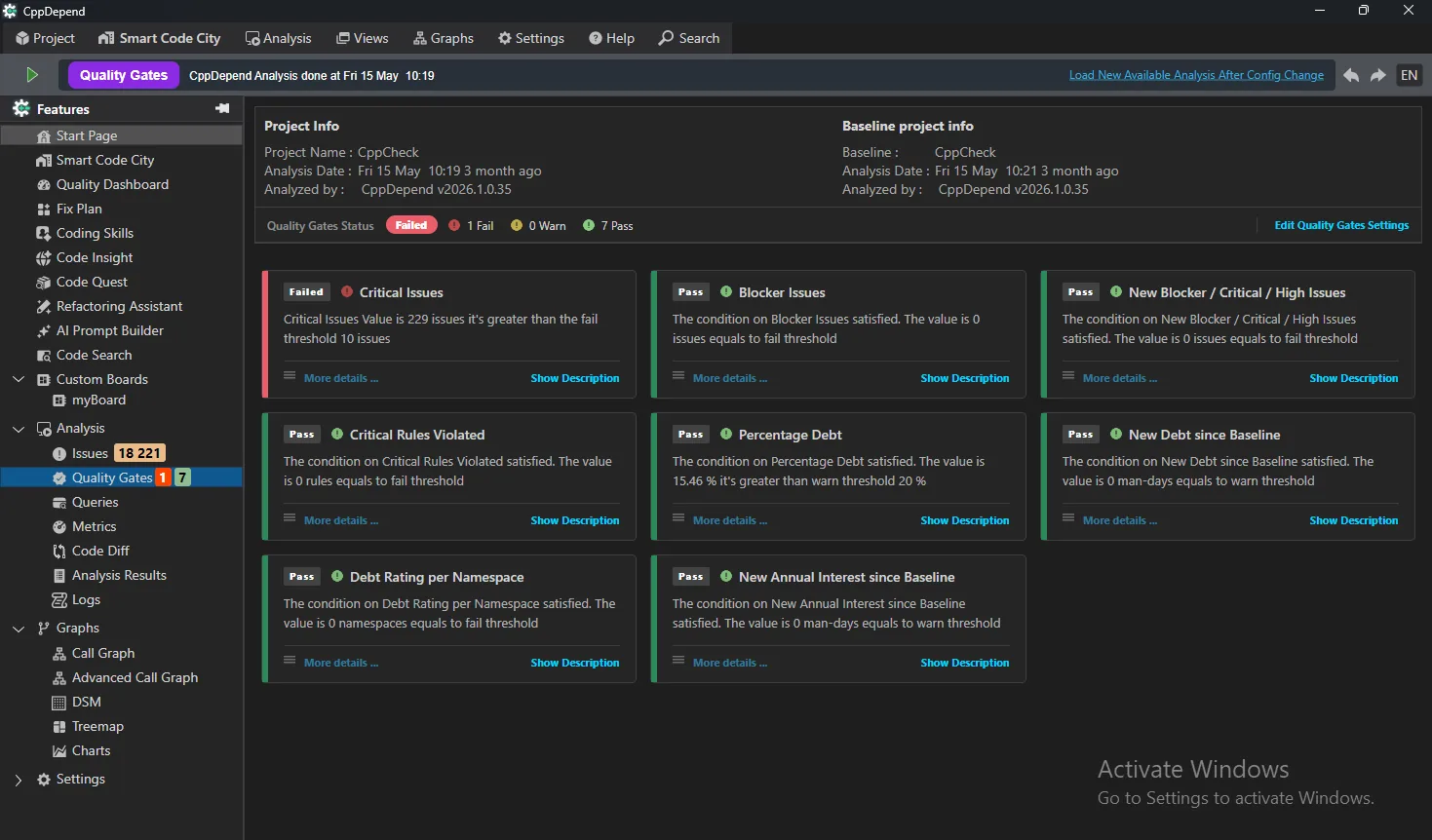
Quality gates block unsafe code in CI — so suppliers and in-house teams deliver against the same, objective bar.
- Jenkins, GitLab CI, GitHub Actions and Azure DevOps
- Fail the build on new critical issues or debt
- Track trends across releases and product variants
No new build system. No workflow change.
CppDepend parses your code with Clang from the build description you already have, and brings findings into the tools your team already uses.
Build inputs
IDEs
Import your analyzers
Your code is your IP. It never leaves your network.
Source code is often your most valuable — and most regulated — asset. CppDepend analyzes it where it lives.
100% on-premiseRuns on your workstations and build servers. No source upload.
Air-gap readyWorks fully offline — ideal for defense, medical and secure labs.
No cloud accountNothing to provision, nothing to approve with your security team.
Over 85% of coding standard enforcement now automated for engine management and ADAS software.
A major automotive supplier faced growing complexity in its engine-management and ADAS codebase, under strict MISRA and ISO 26262 requirements.
Read the full case studyQuestions automotive teams ask us
Which automotive standards are supported out of the box?
MISRA C, MISRA C++ and AUTOSAR C++14 are built in, together with CERT C, CERT C++ and CWE. ISO 26262 objectives are supported through these rule sets, custom Code Quest rules, architecture validation and quality gates.
Can CppDepend be used in an ISO 26262 project?
Yes. Teams use it for coding-guideline checks, architecture analysis and traceable reports that support their ISO 26262 verification activities.
Does our source code ever leave our network?
No. CppDepend runs entirely on your workstations and build servers. It works fully offline and in air-gapped labs — no upload, no cloud account.
Can it analyze our build?
CppDepend parses your code with Clang from your existing build description: Visual Studio solutions, a CMake JSON compilation database, Makefiles, or the Build Monitor, which records the compiler calls of your build.
Which operating systems and languages are supported?
CppDepend runs on Windows, Linux and macOS, and its user interface is available in English, German, French, Spanish, Chinese, Japanese and Korean.
How can we evaluate CppDepend on our code?
Start a 30-day full-featured trial, or request a guided PoC: we run CppDepend on your codebase with you and review the results together.
CppDepend works wherever C and C++ run
Not quite your industry? The same analysis engine serves every kind of C/C++ codebase.
See what CppDepend finds in your ECU code
Analyze your own codebase in minutes — coding standards, architecture and quality gates included.
Full-featured trial · No credit card required · Runs on-premise