

In this post, we explore why EDG’s procedural C architecture relies on monolithic dispatchers and interconnected header files, and why attempting to refactor them would actually hurt performance and maintainability.
Let’s explore CppDepend’s Smart Code City for the EDG front-end:
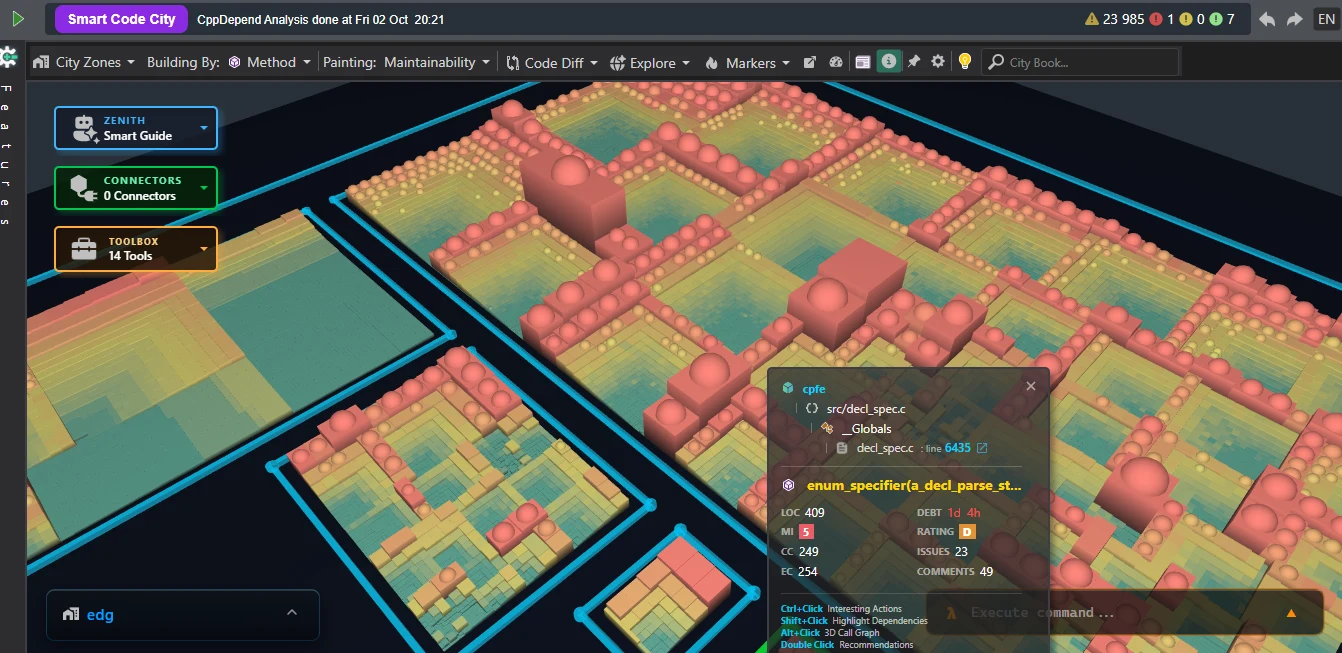
What the Visual Patterns Reveal in the EDG Front-End
Looking at the rendered city overview of EDG, several macro-architectural traits become instantly visible:
- Domes Highlight High Coupling Across Core Districts: Notice the clusters of red-tinted buildings topped with domes. In CppDepend’s 3D City, a dome specifically indicates a function with high coupling—meaning it heavily relies on or interacts with many other parts of the codebase. In EDG, core tasks like expression evaluation, type resolution, and declaration processing constantly reach out to global state tables and AST structures. This high interdependency (efferent coupling) causes domes to pop up across the primary code districts.
- Monolithic Dispatch Pillars vs. Flat Neighborhoods: Several distinct, tall monoliths with wide footprints stand out above the surrounding flat blocks. These reflect functions like
process_expr_work: large procedural C switch loops with thousands of lines of code and high cyclomatic complexity. - Color Clustering (Red/Orange Dominance in Central Modules): While utility modules show cooler green/teal surfaces, the core C++ front-end district (
cpfe) shows widespread warm colors. In standard software, widespread red indicates urgent refactoring needs; in an industrial C compiler, it visually proves how tightly integrated the entire parsing and evaluation pipeline must be to process complex C++ semantics efficiently. - Green and Blue Boundary Wires Show Strong Module Health: Notice how the wire borders surrounding the main module zones stay solid green and blue. While individual functions inside are highly complex, CppDepend's boundary wires reflect top-level architectural health, rule compliance, and clean module boundaries.
The Monolithic Core: process_expr_work
In CppDepend's Smart Code City, the function process_expr_work in src/interpret.c stands out as one of the largest structures in the entire EDG codebase:
- Lines of Code (LOC): 2,911
- Cyclomatic Complexity (CC): 1,229
- Efferent Coupling (EC): 506
To a standard static analysis tool, these metrics trigger immediate high-priority refactoring alerts. However, understanding the procedural C design of EDG reveals why this structure is both intentional and effective.
Why process_expr_work Is So Long: The Procedural C Dispatch Loop
Because EDG was historically developed in procedural C, it does not use C++ object-oriented features like class inheritance or virtual function tables.
Instead, the AST (Abstract Syntax Tree) traversal and expression evaluation rely on explicit, tag-based dispatching:
- Tag-Based Discriminators: AST nodes are raw C struct pointers tagged with enum identifiers representing expression kinds (e.g.,
EXPR_BINARY,EXPR_CAST,EXPR_CALL). - Centralized Procedural Switch:
process_expr_workacts as the main interpreter dispatch loop. It executes a single, massive C switch statement that branches across hundreds of AST node kinds. - Local Register Allocation & Zero Call Overhead: Keeping expression evaluation steps inside a single function scope avoids pushing stack frames or making indirect function calls during recursive AST traversals. It also allows standard C compilers to optimize register allocation across local temporary variables.
How Clang Implements the Same Behavior
Clang parses and evaluates expressions for the exact same C++ language specification, but it takes an object-oriented C++ approach. Comparing EDG's procedural C dispatch to Clang highlights how language paradigms change the static analysis signature while preserving the underlying architectural requirements:
| Metric / Feature | EDG (process_expr_work) | Clang (ExprConstant.cpp) |
|---|---|---|
| Language Paradigm | Procedural C | Modern C++ (Object-Oriented) |
| Architecture Pattern | Centralized tagged switch dispatch loop | AST Visitor Pattern (ConstStmtVisitor) |
| Code Structure | Single monolithic function (2,900+ LOC) | Distributed across class hierarchy (VisitExpr, VisitCast, etc.) |
| Static Analysis Signature | Vertical complexity: high CC (1,229) in one function | Horizontal complexity: lower CC per method, but higher class count |
| Call Stack & Memory | Low stack overhead; optimized register reuse | Virtual/overloaded method calls across class hierarchies |
| Context Passing | Direct access to local function scope & state | Explicit context objects (EvalInfo&) passed to methods |
Where the Complexity Goes
In EDG: Complexity is vertical and localized. It accumulates inside process_expr_work, creating high Cyclomatic Complexity (1,229) in a single translation unit.
In Clang: Complexity is horizontal and distributed. Clang splits the evaluation logic across individual Visit* methods across multiple evaluator classes (IntExprEvaluator, FloatExprEvaluator, LValueExprEvaluator).
While Clang avoids 3,000-line single functions, its total systemic complexity remains identical because evaluating C++ expressions—with all implicit conversions, operator overloads, template instantiations, and dialect edge cases—requires accounting for the exact same rule set.
Whether represented as a 2,900-line procedural C switch in EDG or 50 visitor methods across a class hierarchy in Clang, the underlying domain complexity remains unchanged.
File-Level Dependency Cycles: Reading the Matrix (DSM)
Switching from Smart Code City to CppDepend’s Dependency Structure Matrix (DSM) reveals another major static analysis signature: dense file-level dependency cycles across core translation units.
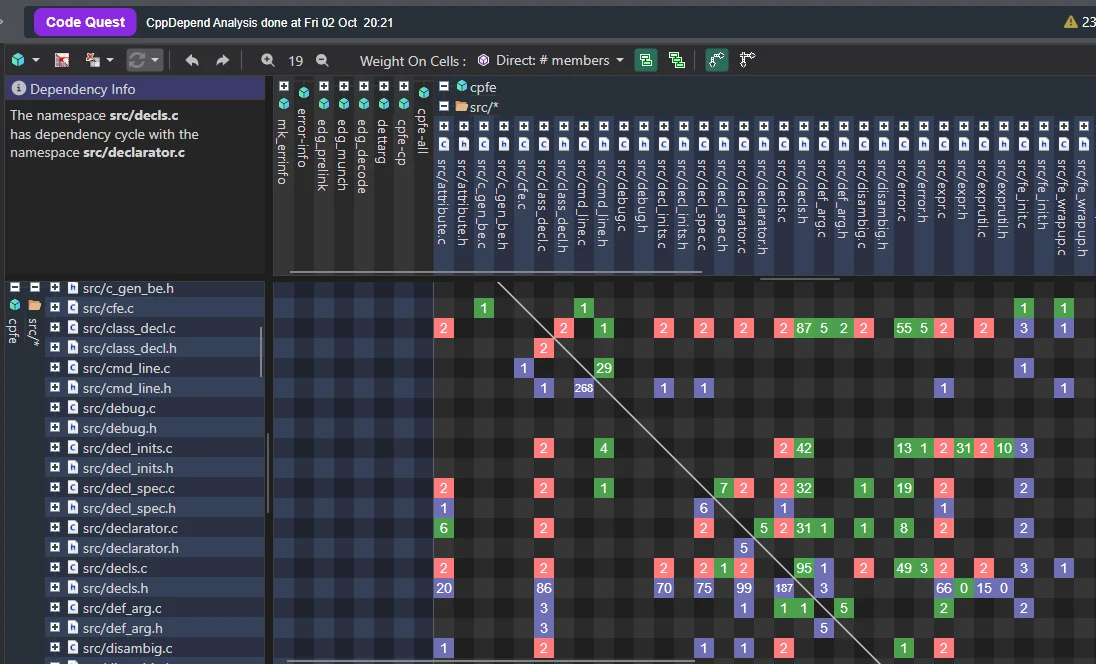
Looking at the DSM grid, files like src/class_decl.c, src/declarator.c, src/decls.c, and src/expr.c form a prominent Strongly Connected Component (SCC):
- Blue Cells: Indicate unidirectional, layered dependencies (File A depends on File B, but not vice-versa).
- Red Cells: Mark bidirectional dependencies (cycles), where two files directly or indirectly rely on each other’s symbols and definitions.
- Cell Numbers: Show the exact member coupling weight (e.g.,
declarator.cusing 31 members fromdecls.hand 5 members fromdeclarator.h).
The class_decl.c && declarator.c Interdependency
In traditional enterprise C/C++ architecture, circular dependencies between translation units are considered a severe design flaw.
Dissecting the Cycle: Pragmatic Mutual Recursion vs. Accidental Coupling
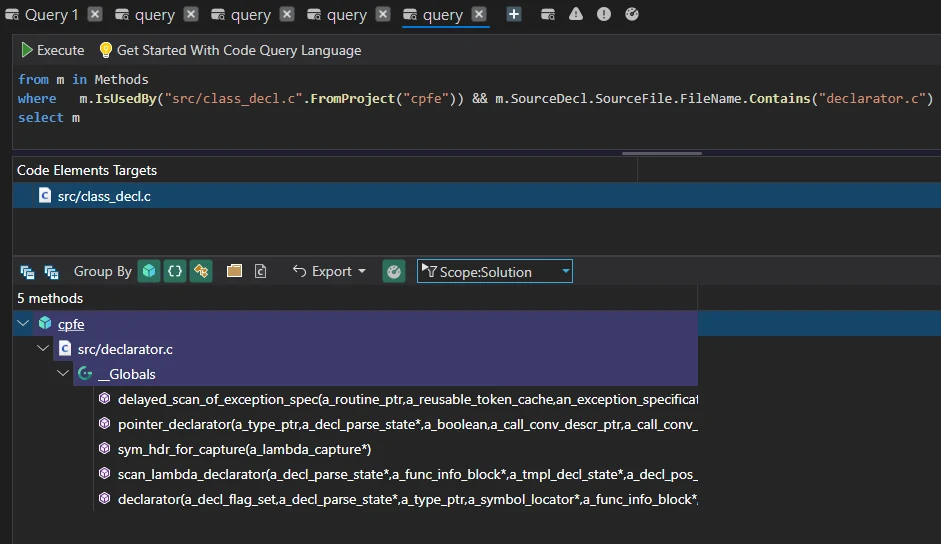
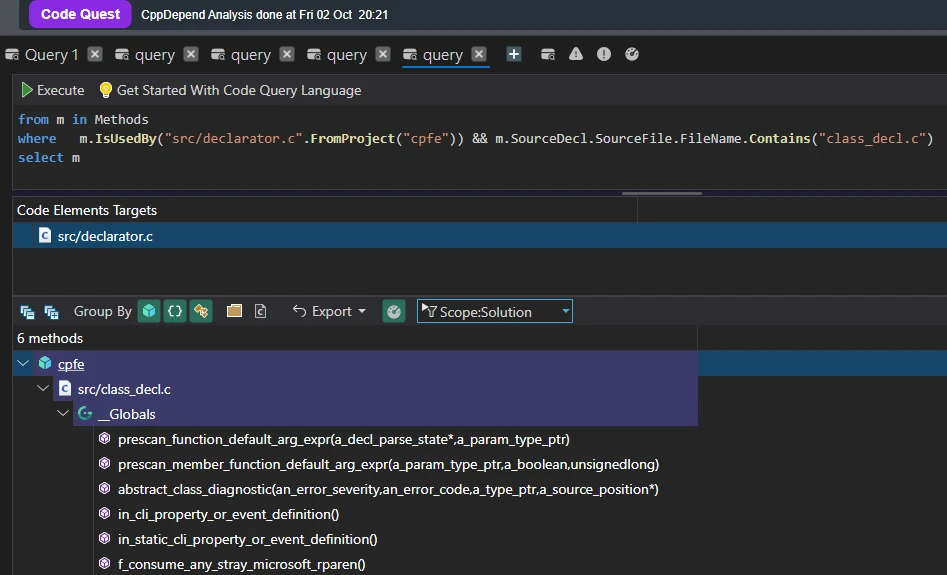
Using Code Quest in CppDepend, we can inspect the precise function calls driving the bidirectional cycle between src/class_decl.c and src/declarator.c.
By querying methods in class_decl.c used by declarator.c and vice versa, we reveal two distinct categories of coupling: Pragmatic Cycles that reflect fundamental language rules, and Accidental Cycles that can easily be refactored.
Functions from declarator.c used by class_decl.c:
Functions from class_decl.c used by declarator.c:
The class_decl.c ↔ declarator.c Dependency Cycle Intention
1. Pragmatic Mutual Recursion
(Keep as intentional design)
declarator()scan_lambda_declarator()abstract_class_diagnostic()
2. Accidental / Refactoring Targets
(Candidates for decoupling)
f_consume_any_stray_microsoft_rparen()in_cli_property_or_event_definition()in_static_cli_property_or_event_definition()
1. The Pragmatic Side: Inherent Language Mutual Recursion
When parsing modern C++, class definitions and declarator parsing are inherently tied together. The Code Quest queries surface core functions that justify the dependency:
A. declarator.c → class_decl.c
abstract_class_diagnostic(...): Called from declarator.c when a function or variable declaration attempts to instantiate or return an abstract class. The declarator parser must query class layout metadata from class_decl.c to evaluate pure virtual functions and issue diagnostics.
B. class_decl.c → declarator.c
declarator(...) & scan_lambda_declarator(...): Called from class_decl.c whenever a class definition encounters member function declarators, pointers-to-members, or nested lambdas.
delayed_scan_of_exception_spec(...): Exception specifications on member functions can only be processed after parsing relevant class contexts.
Attempting to eliminate these core calls by over-abstracting would introduce artificial wrapper layers and execution performance penalties. In compiler engineering, this mutual recursion is pragmatic, domain-driven design.
2. The Refactoring Opportunities: Accidental Utility Coupling
However, Code Quest also isolates functions in the cycle that have little to do with core C++ parsing grammar and represent accidental architectural coupling:
Looking at the 6 returned methods in class_decl.c:
- Dialect/Parser Helpers:
f_consume_any_stray_microsoft_rparen() - CLI/Extension Helpers:
in_cli_property_or_event_definition()andin_static_cli_property_or_event_definition()
Why These Create Unnecessary Cycles
f_consume_any_stray_microsoft_rparen() is a parser recovery utility for handling MSVC-specific syntax quirks. Placing it inside class_decl.c forces declarator.c to depend on the entire class declaration unit just to consume a token!
How to Remove the Accidental Cycle
- Extract Utility Helpers: Moving dialect recovery routines (
f_consume_...) and CLI state checks into a dedicated utility module (e.g.,src/parser_utils.corsrc/lex_helpers.c) breaks the artificial link. - Result: The 6-method coupling footprint shrinks, eliminating the accidental cycle while preserving the necessary, high-performance C++ grammar dispatch loops.
Key Takeaway for Architects
Static analysis tool warnings should never be treated with a blanket “fix all cycles” rule.
Using tools like CppDepend and Code Quest, teams can distinguish between domain-essential cycles (like declarator() ↔ abstract_class_diagnostic()) that belong in a C++ parser engine, and accidental utility placement (like MSVC token recovery helpers) that can be cleanly refactored out.
Because C++ permits inline class definitions, member functions, nested classes, and trailing return types, class definition parsing and declarator parsing are fundamentally mutually recursive.
Why C Header Mechanics Exacerbate the Cycles
Because EDG is engineered in procedural C, it relies on shared header definitions (class_decl.h, declarator.h, decls.h).
- Shared C Types: Data structures like
a_type_ptr,a_decl_ptr, anda_declaratormust be visible across both translation units. - Cross-Inclusion & Forward Declarations: While clean C++ might use interfaces or Pimpl patterns to decouple headers, C codebases rely on cross-including headers and forward-declaring raw struct pointers. In the DSM, this surfaces as dense red clusters across
class_decl.c,declarator.c, anddecls.c.
Key Takeaway for Matrix Analysis
In standard software architectures, a red square in a DSM means “break this up using interface abstraction.”
In an industrial compiler front-end, a red matrix cluster between class_decl, declarator, decls, and expr simply reflects the reality that C++ grammar rules cannot be neatly layered into a pure directed acyclic graph (DAG). The cycles are not accidental architectural drift—they mirror the mutual recursion built into the C++ language specification itself.
The Quality Dashboard: Deciphering 23,000+ Low-Severity Issues
When reviewing CppDepend’s high-level Quality Dashboard for EDG, a striking statistical paradox emerges:
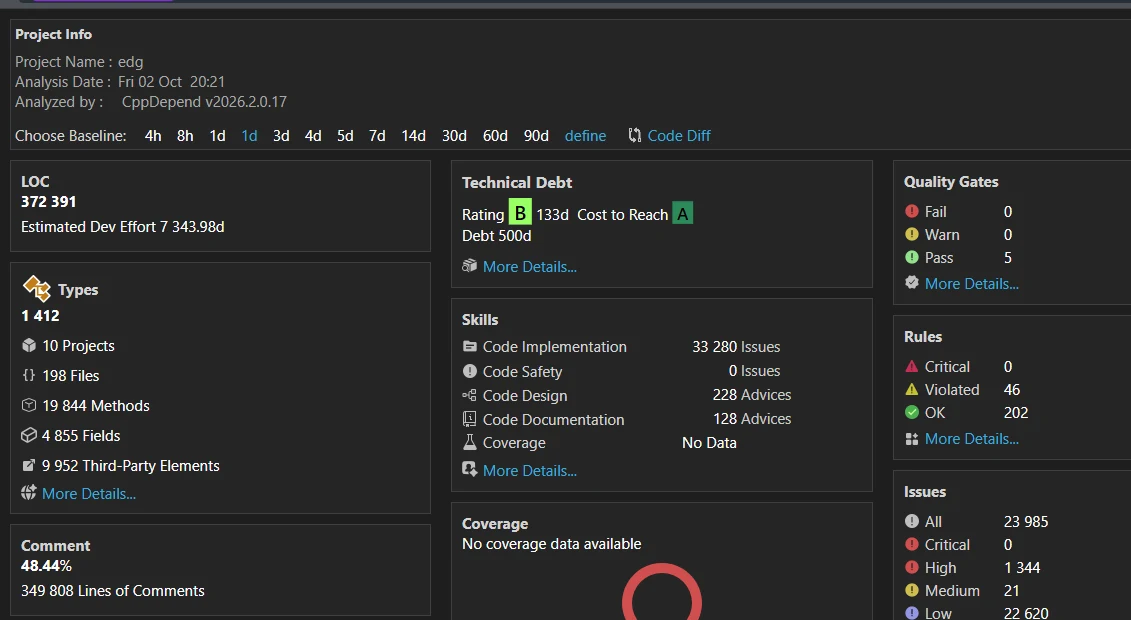
EDG Quality Dashboard at a Glance
| Metric / Category | Value / Details |
|---|---|
| Total Lines of Code (LOC) | 372,391 |
| Total Issues | 23,985 |
| Low-Severity Issues | 22,620 (~94% of total) |
| High-Severity Issues | 1,344 |
| Critical Rules Violated | 0 |
| Quality Gate Status | 5/5 PASSED |
At first glance, seeing 23,985 total issues might look alarming. However, looking at the breakdown reveals why EDG achieves an overall Rating B and passes all 5 Quality Gates cleanly without triggering a single Fail or Warn status.
1. Severity Breakdown: Noise vs. Critical Risk
The dashboard classifies issues into distinct severity tiers:
- Critical Issues: 0 (No severe memory leaks, undefined behavior, or system-breaking flaws).
- High-Severity Issues: 1,344 (Mainly concentrated in high Cyclomatic Complexity functions like
process_expr_work). - Medium-Severity Issues: 21
- Low-Severity Issues: 22,620 (~94% of all reported issues)
The vast majority of the total issue count comes from low-severity code style guidelines, such as MISRA C/C++ static analysis checks.
2. The MISRA C Effect: Formatting Rules Scale with LOC
Because EDG is written in procedural C, static analysis rules like MISRA C enforce strict syntactic guidelines across all 372,391 lines of code. A classic example is:
“An if(condition) construct shall be followed by a compound statement (curly braces {}).”
In classic procedural C, single-line if statements without explicit braces are common:
// Triggers low-severity MISRA C style violation in every instance
if (expr == NULL) return;

// Compliant MISRA C form
if (expr == NULL) {
    return;
}
When a 370,000+ LOC codebase omits optional braces or uses macro style patterns throughout thousands of switch cases, CppDepend flags every single occurrence as an issue.
While these rules generate tens of thousands of individual warnings, they carry minimal technical debt impact per instance, which is why Code Implementation shows 33,280 issues while Code Safety shows 0 issues.
3. High Comment Density Reflects Strong Documentation
Another standout metric on the dashboard is the Comment Ratio:
- Comment Percentage: 48.44%
- Lines of Comments: 349,808
Nearly 50% of the entire EDG codebase consists of comments. For every line of executable procedural C code, there is almost a full line of documentation explaining C++ standard compliance quirks, compiler flags, and language dialect edge cases.
This exceptional comment density explains why, despite structural complexity in AST traversal dispatchers, the codebase remains highly maintainable for its domain.
Key Takeaway
The Quality Dashboard demonstrates why raw issue counts can be misleading without severity classification.
EDG's 22,620 low-severity issues are cosmetic style and formatting violations (like MISRA brace compliance). Because the engine maintains zero critical rule violations and a 48% comment density, it satisfies CppDepend's top-level Quality Gates while supporting industrial-grade C++ parsing.
Conclusion: Balancing Static Metrics with Domain Architecture
Analyzing a mature, industrial-grade codebase like the EDG C/C++ front-end with CppDepend offers a powerful lesson in software architecture: static analysis metrics are diagnostic indicators, not absolute dogmas.
Lessons from the EDG Analysis
| Key Takeaway | Architectural Insight |
|---|---|
| 1. Context Over Metric Dogma | A 2,900-line function with CC 1,229 isn't always technical debt—in a C-based AST interpreter, it prevents call stack allocation and register overhead. |
| 2. Distinguishing Cycle Types | Mutual recursion in grammar parsing (declarator ↔ class_decl) is pragmatic, while stray MSVC token helpers are actionable technical debt. |
| 3. Macro vs. Micro Health | Despite high local function complexity, green frontier wires and a 48% comment density prove disciplined system-level engineering. |
Key Engineering Takeaways
- High Complexity Can Be Intentional Design: Functions like
process_expr_workachieve astronomical Cyclomatic Complexity scores (1,229) because they centralize C++ AST expression evaluation into high-throughput procedural C dispatch loops. Splitting every branch into separate functions would increase parameter drilling, stack frame overhead, and cache misses without reducing the inherent complexity of the C++ language specification. - Not All Dependency Cycles Are Created Equal: Through DSM visualization and Code Quest queries, we saw that file-level dependency cycles are often dual-natured:
- Domain-Driven Cycles: Mutual recursion between
class_decl.canddeclarator.cdirectly mirrors the recursive rules of C++ grammar (class definitions contain declarators; declarators require class context). - Accidental Cycles: Placing token parser helpers (like
f_consume_any_stray_microsoft_rparen()) inside core class modules creates unnecessary cross-file coupling that can be cleanly refactored.
- Domain-Driven Cycles: Mutual recursion between
- Severity Classification Prevents Metric Panic: EDG’s Quality Dashboard registers nearly 24,000 total issues. Yet with 0 critical rules violated, 5/5 passed quality gates, and ~94% low-severity warnings driven by strict style checks (such as MISRA C brace compliance), the project achieves a solid Rating B. Coupled with a 48.44% comment density, the codebase demonstrates exceptional maintenance hygiene despite its raw structural scale.
The Final Word for Software Architects
Static analysis tools like CppDepend are invaluable for exposing structural heatmaps, architectural boundaries, and hidden coupling. However, the goal of static analysis in complex engineering domains is not to force every metric to green at all costs.
By combining automated visualization with a deep understanding of domain constraints—whether building a compiler front-end, a game engine, or a real-time OS—architects can distinguish between true, decaying technical debt and pragmatic, high-performance design decisions.