
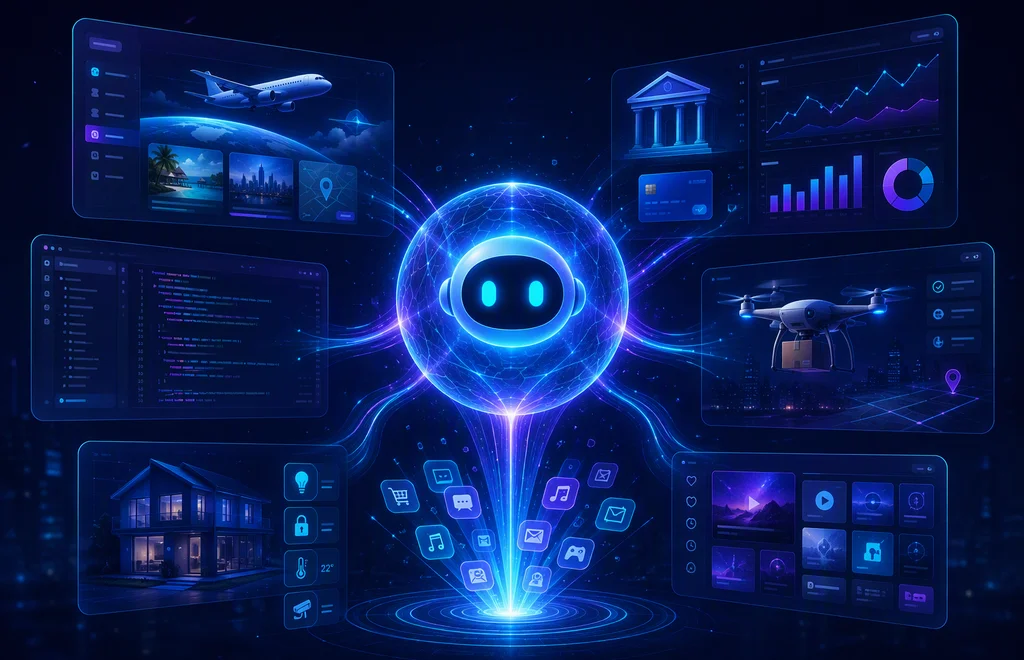
Since the rise of Large Language Models (LLMs), we have been witnessing a profound yet quiet revolution: the unification of technology. Today, AI serves as a universal interface for interacting with code, APIs, databases, and operating systems.
However, this is only the first phase. We are rapidly transitioning into the next, even more disruptive era: AI as a single, unified interface to all real-world and digital services.
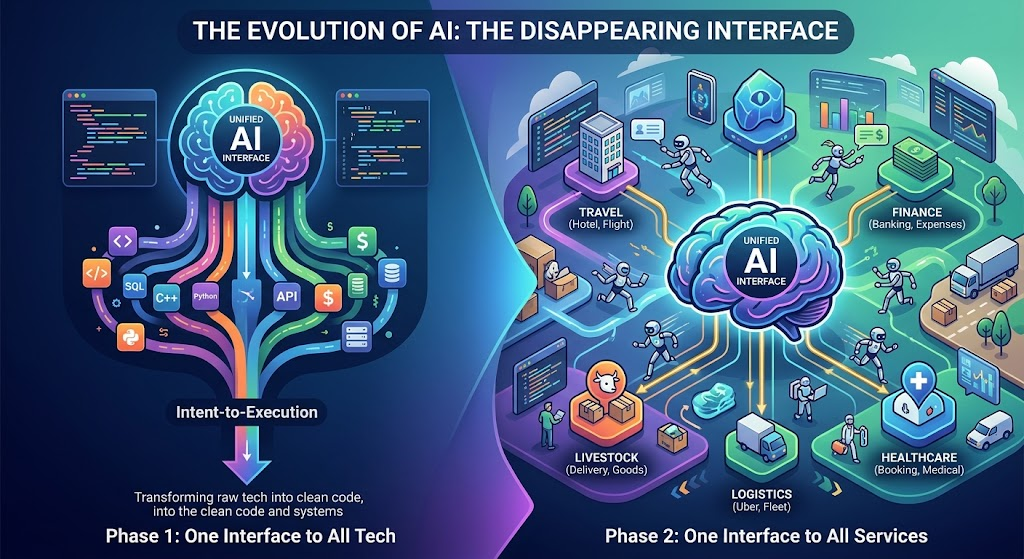
Phase 1: One Interface to All Tech
For decades, mastering technology required learning its specific languages and syntax:
- SQL to query a database.
- C++, Python, or Rust to build software applications.
- Bash commands to manage server infrastructure.
- REST/GraphQL APIs to bridge distinct systems.
AI broke down these barriers. By translating natural language directly into executable technical instructions, LLMs became the universal abstraction layer on top of the technology stack. You no longer need to write the perfect syntax or query yourself—AI interprets your intent, generates code, inspects the AST (Abstract Syntax Tree), or directly interacts with compilers and runtimes.
Where we are today: AI has democratized software engineering by becoming the ultimate real-time translator between human intent and machine execution.
Phase 2: One Interface to All Services
While the first phase was about manipulating technology, the second phase is about delegating the execution of real-world services.
In the near future, users will stop opening dozens of fragmented apps (Uber, Booking, banking portals, food delivery, flight aggregators, or cloud consoles). Instead, AI will become the overarching orchestration layer: Agent-as-an-Interface.
What changes fundamentally:
- The End of App Fragmentation: instead of navigating through multiple complex Graphical User Interfaces (GUIs), you express a high-level outcome: “Organize my trip to the Paris conference, book the hotel based on my past preferences, and file my expense reports.”
- Autonomous Connected Agents (Function Calling & Agent Protocols): AI transitions from a passive chatbot into an active network of agents capable of negotiating, booking, paying, and executing multi-step workflows end-to-end via third-party APIs.
- The Inversion of Value: value will no longer reside in owning the front-end user interface (the mobile app screen), but in the efficiency, reliability, and security of the underlying backend service that agents connect to.
Architectural Deep Dive: How the Stack is Shifting
The transition from GUI-first to Agent-first software requires a complete redesign of the modern tech stack:
| Layer | Traditional Stack (GUI Era) | Modern AI Stack (Agent Era) |
|---|---|---|
| Front-End | React, Flutter, iOS/Android Apps | Natural Language / Ambient Voice / Agent Prompts |
| Middle Layer | REST APIs / GraphQL / Microservices | Function Calling / Model Context Protocol (MCP) |
| Execution | Manual Human Navigation | Autonomous Tool-Using Agents & Sub-Agents |
| Verification | Form Validation / Client-Side Checks | Formal Verification / Deterministic Safety Enclaves |
In this new stack, the API is the product. Services that fail to provide clean, machine-readable agent endpoints will simply become invisible to the unified interface.
The Economic Disruption: The Invisible App Economy
When the AI interface absorbs the user interaction layer, business models across the software industry will be forced to pivot:
- Ad-Driven Models in Peril: current web monetization relies on driving human eyes to screens to display banner ads and sponsored links. When an AI agent books a flight or orders groceries in 200 milliseconds via API, traditional display ad revenue collapses.
- The API-Economy Premium: platforms will charge based on agent transaction velocity and execution speed rather than user seat licenses.
- Agent Neutrality as a Business Battleground: whichever platform controls the primary agent interface (Apple, OpenAI, Google, Anthropic) wields immense gatekeeping power. Regulators will soon debate “Agent Neutrality”—ensuring an AI agent doesn’t unfairly prefer its own parent company’s flight or hotel booking service over competitors.
Critical Challenges on the Horizon
Replacing traditional graphical interfaces with a single, unified AI interface introduces significant technical and strategic hurdles:
- Security & Determinism: granting AI agents the power to execute financial transactions or sign agreements requires formal code verification, strict memory safety, and deterministic safety boundaries.
- Agent-First APIs: service providers will need to redesign their infrastructure away from human-centric UIs and toward standardized, machine-readable agent protocols (e.g., Model Context Protocol).
- Control & Neutrality: whichever ecosystem controls the unified interface effectively controls access to the entire digital market. Agent neutrality will become a massive economic and regulatory battleground.
Conclusion: The Disappearing Interface
The history of computing is defined by successive layers of abstraction: from punch cards to command-line interfaces (CLI), to graphical user interfaces (GUI), and mobile app ecosystems.
The shift from “One Interface to All Tech” to “One Interface to All Services” marks the gradual invisible fading of the traditional app screen. Tomorrow, the most powerful software won’t be an app you tap on—it will be the agent that seamlessly executes your intentions in the physical and digital world.
Building the backend services that AI agents will rely on? Try CppDepend to keep your C/C++ codebase clean, verifiable and agent-ready.