
In game development and high-performance graphics, developers often debate whether classic Object-Oriented Programming (OOP) still holds up against pure Data-Oriented Design (DOD). While cache locality and contiguous memory buffers are crucial for modern GPU pipelines, the Object-Oriented Graphics Rendering Engine (OGRE 3D) stands as a premier example of OOP done right.
1. True Abstraction: Hiding Low-Level Graphics APIs
A core objective of OOP is abstraction — providing a clean, high-level mental model while hiding complex implementation details.
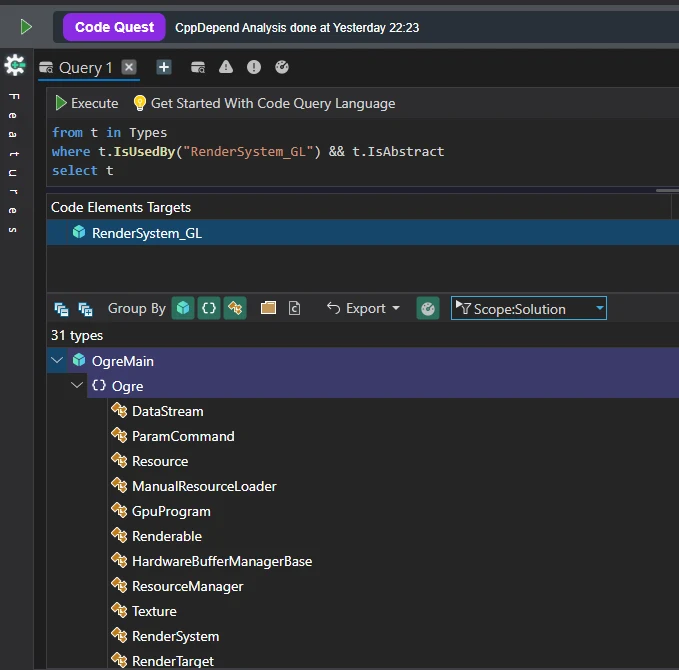
OGRE abstracts low-level graphics APIs by decoupling scene management from driver-level rendering. Using CppDepend, we can inspect how concrete drivers (like RenderSystem_GL or RenderSystem_Direct3D11) interact with OgreMain abstractions:
The Architectural Takeaway
By deriving concrete backends from key abstract contracts like RenderSystem, Texture, and HardwareVertexBuffer, OGRE ensures that adding a new rendering API (e.g., Vulkan or WebAssembly/WebGL) requires zero structural changes to application logic or scene graph traversal.
2. Polymorphism without Inheritance Abuse
A common pitfall in C++ frameworks is over-inheritance — creating deep, fragile class hierarchies or abusing multiple inheritance. OGRE maintains exceptional cohesion by preferring composition over inheritance and keeping hierarchies shallow.
We can run a Code Quest query to check the depth of inheritance across the core library:
from t in Types
where t.BaseClasses.Count() > 1
select new { t, NbBaseClasses = t.BaseClasses.Count(), t.DepthOfInheritance }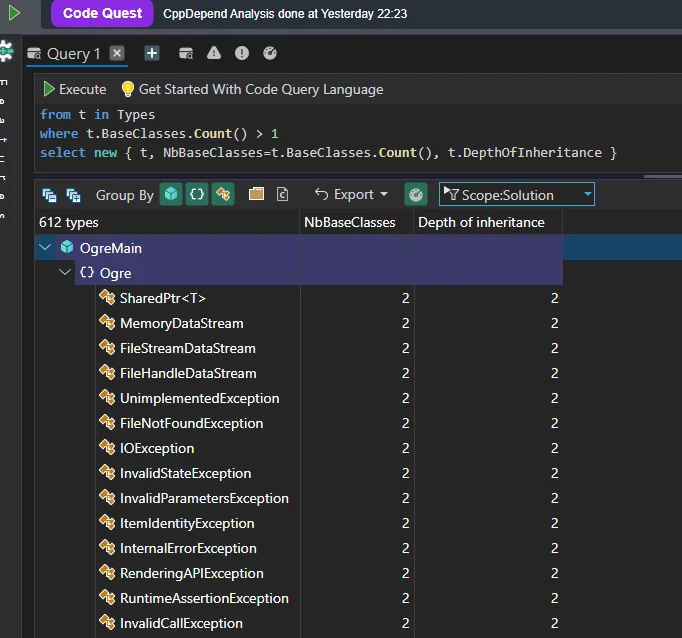
What the Data Shows
- Shallow Inheritance Trees: most classes in OgreMain have a Depth of Inheritance Tree (DIT) ≤ 3.
- Controlled Multiple Inheritance: only a tiny fraction of types derive from more than one base class. Multiple inheritance in OGRE is restricted primarily to mixin interfaces (such as deriving from both a domain interface and a listener or factory base class).
3. Clean Instantiation with Factory and Singleton Patterns
In large C++ applications, uncontrolled object instantiation creates tight coupling. OGRE solves this using two fundamental creational patterns:
Factory Pattern for Object Creation
Instead of allowing client code to instantiate concrete objects directly with new, OGRE delegates creation to specialized factory classes (e.g., EntityFactory, SceneManagerFactory).
from m in Methods
where m.DepthOfCreateA("Ogre.Entity") == 1
select m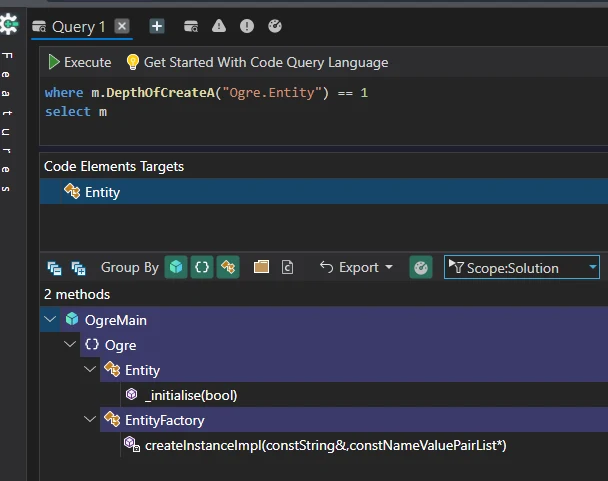
Result: only EntityFactory directly instantiates Entity objects, ensuring memory management and object lifecycle hooks remain completely encapsulated.
Singleton Managers for System State
OGRE centralizes subsystem management using singletons derived from a thread-safe template (Ogre::Singleton<T>):
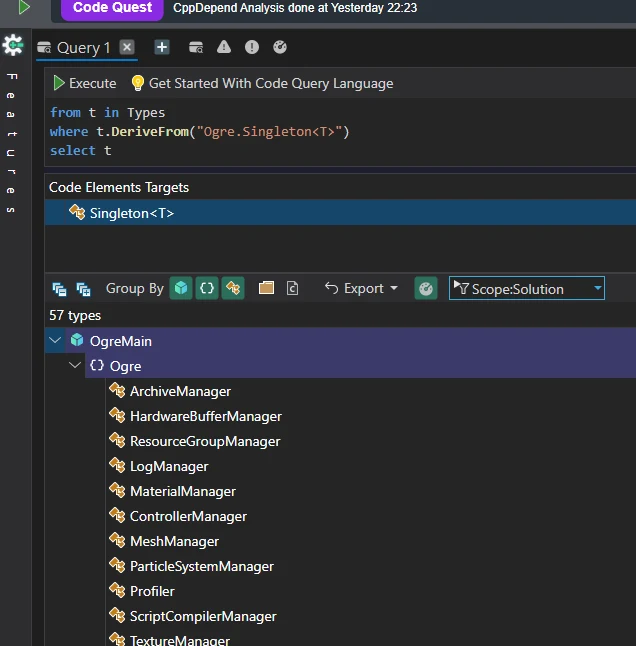
Subsystems like MeshManager, TextureManager, and MaterialManager inherit from this uniform template, giving developers predictable, thread-safe access to engine resources.
4. The Facade Pattern: Simplifying Engine Subsystems via Ogre::Root
Managing dozens of specialized managers, loaders, and render targets can overwhelm client applications. OGRE uses the Facade Pattern in its entry point class: Ogre::Root.
Using CppDepend's Efferent Coupling (EC) metric — which measures the number of types a class depends on — we see that Ogre::Root has high coupling (EC > 100).
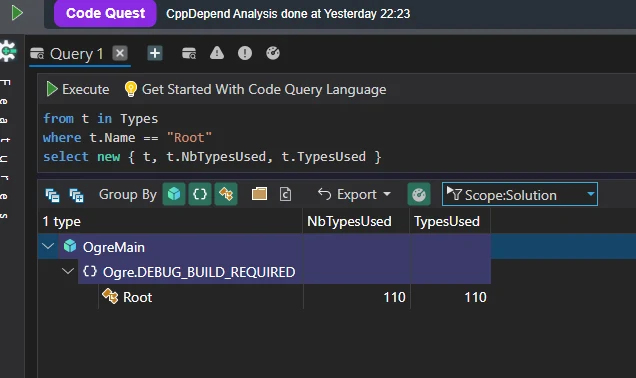
While high coupling is usually a code smell for standard classes, for a Facade, it is a deliberate design choice. Root orchestrates initializations, frame listeners, rendering loops, and manager lifecycles behind a unified, easy-to-use API.
5. Abstractness vs. Instability Graph
Robert C. Martin wrote an interesting article about a set of metrics that can be used to measure the quality of an object-oriented design in terms of the interdependence between the subsystems of that design.
Here's what he says in the article about the interdependence between modules:
What is it that makes a design rigid, fragile and difficult to reuse. It is the interdependence of the subsystems within that design. A design is rigid if it cannot be easily changed. Such rigidity is due to the fact that a single change to heavily interdependent software begins a cascade of changes in dependent modules. When the extent of that cascade of change cannot be predicted by the designers or maintainers the impact of the change cannot be estimated. This makes the cost of the change impossible to estimate. Managers, faced with such unpredictability, become reluctant to authorize changes. Thus the design becomes rigid.
And to fight rigidity, he introduces metrics like afferent coupling, efferent coupling, abstractness and instability.
Afferent Coupling: the number of types outside this project that depend on types within this project.
Efferent Coupling: the number of types outside this project used by types of this project.
Efferent coupling and afferent coupling can also be applied to namespaces and types. For example, the efferent coupling for a particular type is the number of types it directly depends on. Types where TypeCe is very high depend on too many other types. They are complex and in general have more than one responsibility.
Abstractness
The ratio of the number of internal abstract types (i.e., abstract classes and interfaces) to the number of internal types. The range for this metric is 0 to 1, with A=0 indicating a completely concrete project and A=1 indicating a completely abstract project.
A = Na / NcWhere:
- A = abstractness of a module. Zero is a completely concrete module. One is a completely abstract module.
- Na = number of abstract classes in the module.
- Nc = number of concrete classes in the module.
Instability
The ratio of efferent coupling (Ce) to total coupling. This metric is an indicator of the project's resilience to change. The range for this metric is 0 to 1, with I=0 indicating a completely stable project and I=1 indicating a completely unstable project.
I = Ce / (Ce + Ca)- I represents the degree of instability associated with a project.
- Ca represents the afferent coupling, or incoming dependencies.
- Ce represents the efferent coupling, or outgoing dependencies.
Abstractness vs. Instability Graph and the Zone of Pain
Here is the Abstractness vs. Instability graph of the Ogre project.
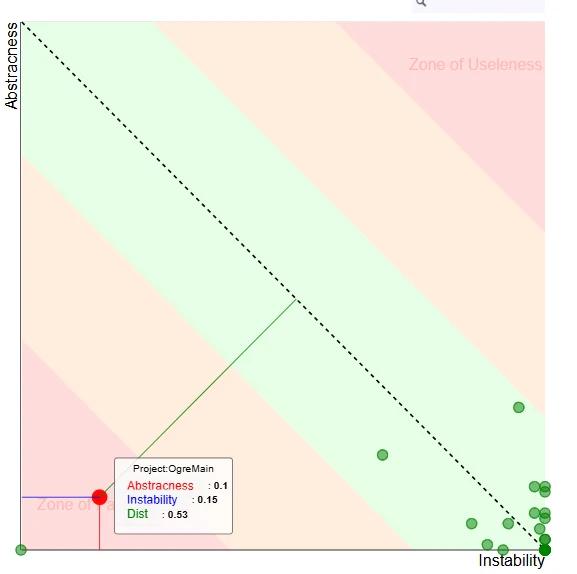
The idea behind this graph is that the more widely used a code element is within a program, the more abstract it should be. In other words, avoid depending too heavily on concrete implementations; depend on abstractions instead. By a popular code element, I mean a project (but the idea also works for packages and types) that is massively used by other projects of the program.
It is not a good idea to have concrete types that are widely used throughout your codebase. This creates Zones of Pain in your program, where changing the implementations can potentially affect a large portion of the program. And implementations are known to evolve more often than abstractions.
The main sequence line (dotted) in the above diagram shows how abstractness and instability should be balanced. A stable component would be positioned on the left. If you check the main sequence you can see that such a component should be very abstract to be near the desirable line — on the other hand, if its degree of abstraction is low, it is positioned in an area that is called the "zone of pain".
How to Fight Rigidity When Using the OOP Approach?
As Robert C. Martin wrote in his article, we have to use abstract classes and interfaces to make our projects more flexible and reduce the high coupling between code elements.
Coupling in OOP can be introduced by:
- Inheritance: it is often overused when adopting the OOP paradigm, and unfortunately in many cases it makes the code more rigid. Some design patterns are useful to resolve the rigidity introduced by inheritance, like the Adapter pattern, which minimizes the rigidity introduced by inheritance.
- Using a concrete implementation directly: in this case, the code also becomes rigid because it is difficult to change if we need to use another library or framework for some reason. Like with inheritance, there are some design patterns to minimize the rigidity, like the Bridge or the Proxy.
When using the OOP approach, it is recommended to master the GoF structural patterns; they help reduce the rigidity introduced by coupling.
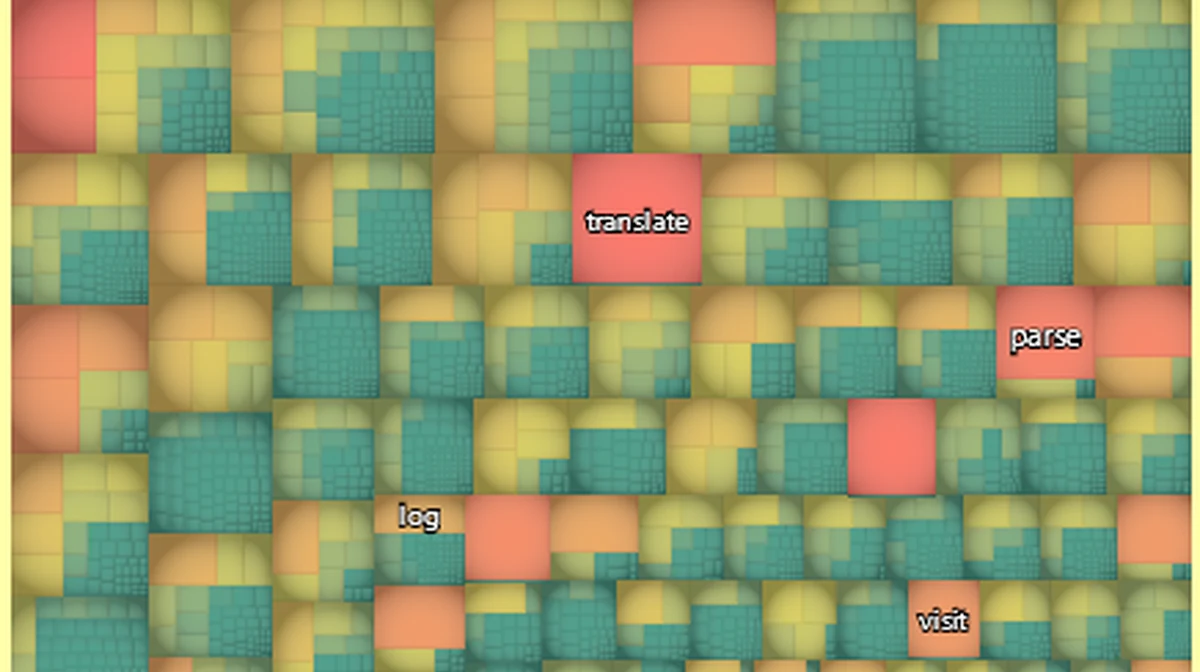
Metric Heatmap Analysis: Method-Level Risk Concentration in OgreMain
The treemap visualizes the codebase hierarchy within the OgreMain component, where rectangle size represents code size (e.g., Lines of Code) and color encoding highlights metric severity (ranging from blue/green for low risk to red for high risk, such as elevated Cyclomatic Complexity or high technical debt).
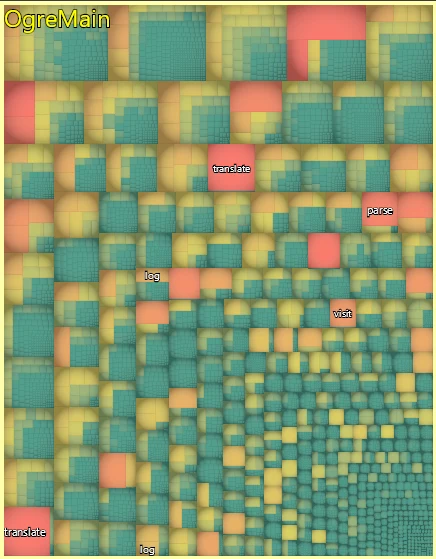
A key takeaway from this visualization is that high-risk metrics are isolated exclusively at the method level rather than indicating system-wide architectural decay across entire classes or namespaces:
- Method-Level Hotspots: the prominent red rectangles scattered across the treemap correspond to specific, individual routines — such as
translate,parse,log, andvisit. These specific functions act as complexity hotspots, likely containing dense control flow (e.g., large switch blocks or nested condition loops). - Healthy Class & Structural Containers: surrounding these method hotspots, the parent containers (classes and namespaces) remain predominantly green and yellow. This indicates that the overarching class organization and module boundaries in OgreMain are structurally sound, with quality bottlenecks concentrated inside isolated member functions.
- Targeted Refactoring Strategy: because the red severity flags are strictly localized to methods like
parseandtranslate, remediation does not require redesigning class hierarchies or interfaces. Refactoring can be targeted directly at decomposing these specific functions into smaller, single-responsibility helper routines.
Summary Metrics: Why OGRE Stands the Test of Time
When analyzing OgreMain with CppDepend, the high-level structural metrics confirm what developers have praised for over two decades:
- High Cohesion: low Lack of Cohesion in Methods (LCOM) scores across core scene components indicate focused, single-responsibility classes.
- Low Cyclomatic Complexity: methods are short, focused, and easily testable, avoiding massive monolithic dispatch loops.
- Clean Module Boundaries: minimal header circular dependencies across namespaces.
Conclusion
OGRE proves that object-oriented programming in C++ is not inherently slow or overly complex when architectural principles are rigorously enforced. By leveraging modern static analysis tools like CppDepend, teams can study engines like OGRE to enforce clean interfaces, prevent architectural decay, and build long-lasting C++ software.