
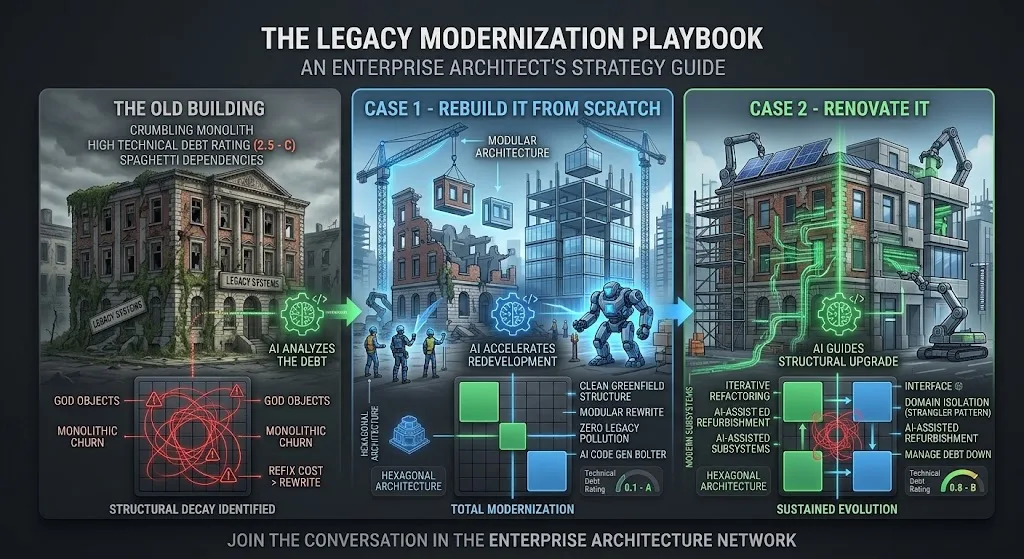
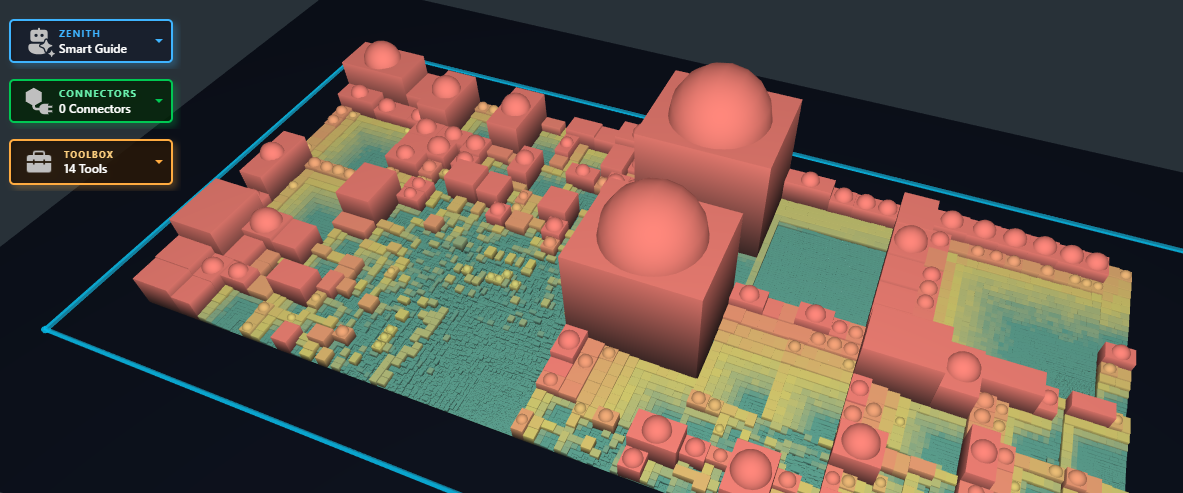
Every enterprise architecture leader eventually faces the legacy ultimatum. You look at the telemetry—what if your Code City looks like an overcrowded, chaotic sprawl of monolithic red towers,
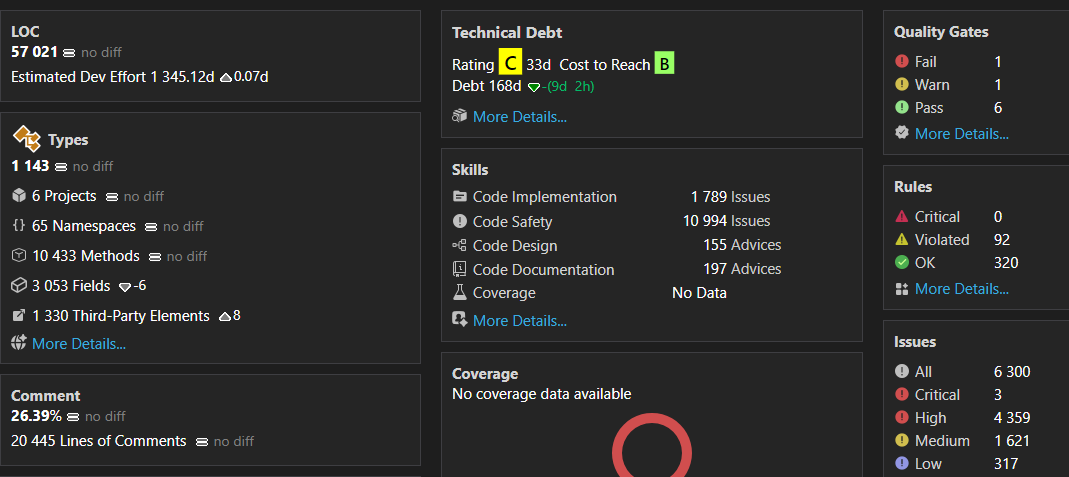
And what if your technical debt is sitting at a heavy rating with massive remediation costs,
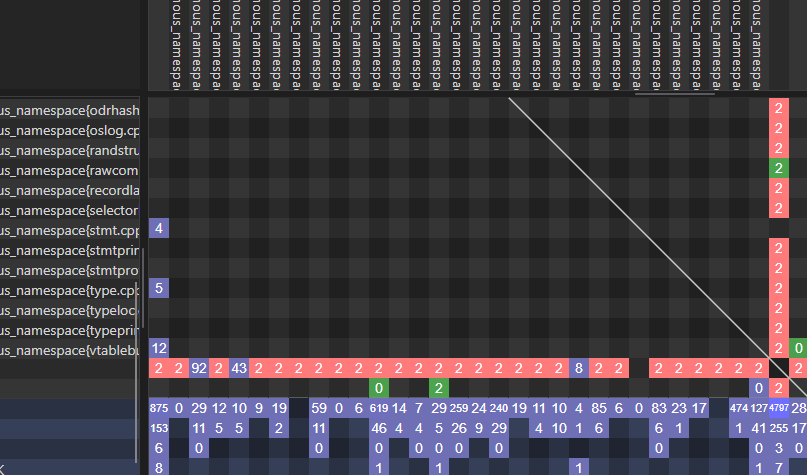
And what if your Dependency Structure Matrix (DSM) lights up with sprawling dependency cycles?
Historically, the "rewrite from scratch" route was widely considered a fatal trap—frequently resulting in runaway budgets, missed business requirements, and recreating the exact same hidden technical debt in a shiny new stack.
However, the rise of modern AI code generation and automated code intelligence is flipping that playbook on its head.
Rewriting legacy systems—or extracting domain logic into modern microservices—is significantly faster and less risky than it was even three years ago. But AI doesn't magically eliminate architectural risk; it changes where the risk lies.
Here is how enterprise architects should evaluate the Rewrite vs. Refactor dilemma in today's AI-accelerated landscape:
1. Why AI Makes Rewriting Viable (And Where It Fails)
AI capabilities—from automated code translation to context-aware boilerplate generation—have drastically collapsed the time required to recreate business logic in modern languages (e.g., migrating C++98 to Modern C++20 or legacy monoliths to microservices).
- The AI Advantage: AI excels at parsing legacy business logic, writing comprehensive unit test matrices for edge cases, and scaffolding clean target architectures in seconds.
- The AI Trap: AI lacks architectural intuition. If you feed AI a heavily entangled, cyclical legacy codebase, it will happily generate a faster, modernized version of the exact same spaghetti architecture.
2. The Structural Discovery Phase: Dependency Mapping Before Prompting
Before unleashing AI assistants or developers to rewrite a system, you must establish strict structural boundaries. You cannot prompt your way out of bad architecture.
- Map the Entanglements: Use automated code intelligence and dependency matrix visualization to identify circular dependencies, tight coupling, and "God objects" across your packages or services.
- Identify the Architectural Seams: Use structural analysis to isolate independent domain modules. These clean seams represent your ideal boundary for an AI-assisted modular rewrite.
- Quantify the Tipping Point: If a module's dependency graph reveals clean, isolated boundaries, AI can help refactor it in place. If it is buried under layers of cyclic links where loosening one knot breaks three others, an AI-accelerated bounded rewrite of that specific domain is now far more efficient than manual refactoring.
3. Continuous Governance: Preventing "AI-Generated Technical Debt"
Because AI allows developers to write code at 10x speed, it also allows them to introduce architectural drift at 10x speed. Modern enterprise architecture requires automated quality gates directly inside the CI/CD pipeline:
- Enforce Layering Rules: Set strict unidirectional dependency rules (e.g., Infrastructure ➔ Core Domain).
- Block Cyclic Dependencies: Automatically fail builds if AI-generated PRs introduce unauthorized cross-module coupling or violate domain boundaries.
- Track Velocity vs. Complexity: Ensure that the speed of code generation isn't ballooning your system's overall cyclomatic complexity.
4. The Multiplier Effect: Why Senior Architect + AI = Superior Redevelopment from Scratch
There has been a persistent myth floating around tech circles that AI coding assistants make greenfield rewrites a push-button commodity—that anyone can prompt a modern app into existence from scratch.
In reality, the exact opposite is true.
When a junior developer or non-technical builder prompts an AI to rewrite a legacy system from scratch, they don't get modern architecture—they get a faster way to generate fresh technical debt. The AI will happily build a working, shiny surface layer that conceals subtle race conditions, unscalable database access patterns, and broken domain boundaries underneath.
AI does not replace architectural intuition, domain boundaries, or system design; it amplifies them. When an experienced architect commands AI during a complete system redevelopment, the result isn't just speed—it is a quantum leap in clean architecture, performance, and long-term maintainability.
Here is how seasoned engineers combine their expertise with AI to achieve exceptional results when redeveloping a platform from scratch:
4.1. Decoupling Legacy Business Logic before Greenfield Scaffolding
Before writing a single line of a new codebase, you must extract the hidden business rules buried across decades of legacy code. An inexperienced developer rewrites what they think the old app did, missing critical edge cases.
- The Greenfield Use Case: Using AI to reverse-engineer and map complex business logic, state machines, and hidden invariants directly out of legacy source code to draft the new target domain model.
- The Expert Advantage: A senior architect knows what to look for and guides the prompt strategy: "Analyze this legacy module, isolate core business validation rules from framework code, and map them into a clean, framework-agnostic Domain-Driven Design (DDD) interface for our new stack." The AI extracts hidden business logic in seconds, ensuring zero functional regression in the fresh rewrite.
4.2. Designing Uncompromising Target Architectures & Interfaces
When starting from a blank slate, AI defaults to standard, monolithic boilerplate unless given strict architectural constraints.
- The Greenfield Use Case: Rapidly scaffolding pristine, multi-tiered architectures (e.g., Hexagonal Architecture, Clean Architecture, or decoupled micro-services) with zero legacy pollution.
- The Expert Advantage: The senior architect sets strict structural boundaries upfront: "Scaffold the core API using strict dependency inversion. Infrastructure modules must depend on domain interfaces, never the reverse. Apply thread-safe memory models for all shared states." The AI generates thousands of lines of pristine, strongly typed boilerplate in minutes, while the architect enforces architectural purity through static analysis quality gates.
4.3. Eliminating Historical Performance & Concurrency Bottlenecks
A legacy rewrite is the ultimate opportunity to fix fundamental design flaws—like poor memory layout, thread contention, or blocking I/O—that were impossible to refactor iteratively.
- The Greenfield Use Case: Replacing legacy execution models (such as deep object hierarchies or synchronous blocking calls) with modern, high-throughput alternatives (like lock-free data structures, std::span, or async execution pipelines).
- The Expert Advantage: The expert spots structural inefficiencies in the old design and directs the AI to evaluate modernized algorithms: "We are dropping our legacy raw pointer tree structure. Help build a cache-friendly, contiguous vector-backed storage model with lock-free concurrency for the new engine." The architect critically evaluates memory footprints and CPU throughput, ensuring the new build isn't just newer, but demonstrably faster.
4.4. Building Rigorous Test Suites & Behavior Matrices from Day One
The biggest failure mode of traditional "rewrites from scratch" is the lack of test parity with the old system, causing production crashes on launch day.
- The Greenfield Use Case: Automatically generating a multi-layered testing harness—including unit, property-based, and integration test matrices—matched against legacy system telemetry before deploying the new stack.
- The Expert Advantage: Senior engineers know happy-path tests are insufficient for a new system. They instruct the AI to aggressively attack the newly generated code: "Generate fuzz testing scenarios, boundary condition matrices, and race-condition checks targeting our new ingestion pipeline." The AI constructs exhaustive test coverage at 10x speed, giving the team total confidence that the fresh build is battle-tested before reaching production.
Summary: The Architect-in-the-Loop Imperative
AI coding assistants are extraordinary accelerators for greenfield redevelopment, but they lack architectural taste, system-level vision, and long-term accountability.
When you pair an experienced architect—who understands domain boundaries, hardware constraints, and security isolation—with AI capable of eliminating days of repetitive scaffolding, redeveloping from scratch ceases to be a high-risk gamble. It becomes a controlled, surgical strategy for total modernization.
The future of enterprise software redevelopment doesn't belong to teams who blindly prompt full applications, nor does it belong to legacy monoliths stuck in endless manual refactoring. It belongs to the seasoned architect who uses AI to re-architect systems right the first time.
A Question for Fellow Enterprise Architects:
Is your organization leaning more toward AI-assisted rewrites now that generation speed has accelerated, or are you still defaulting to strangling legacy monoliths iteratively? How are you governing AI-generated architecture across your teams?